Die "Silberne Husarische Rüstung"
Hussar tournaments were fought in disguise, with participants entering the lists dressed as European or Islamic warriors. We know that such tournaments were organized in Spain and Italy, and that Ferdinand II, Archduke of Austria, also hosted them during his tenure as regent of Bohemia (1547–67). Ferdinand’s hussar tournaments were political spectacles staged by the Habsburg court that reflected the very real military threat posed by the Ottoman Empire. However, we must also see them in the context of the chivalrous romances popular in the sixteenth century; these stories of heroes and heroines, bravery and chivalry, for instance Lodovico Ariosto’s Orlando Furioso (first published in Ferrara in 1532), celebrated not only Christian but also Muslim protagonists as honourable, chivalrous knights.
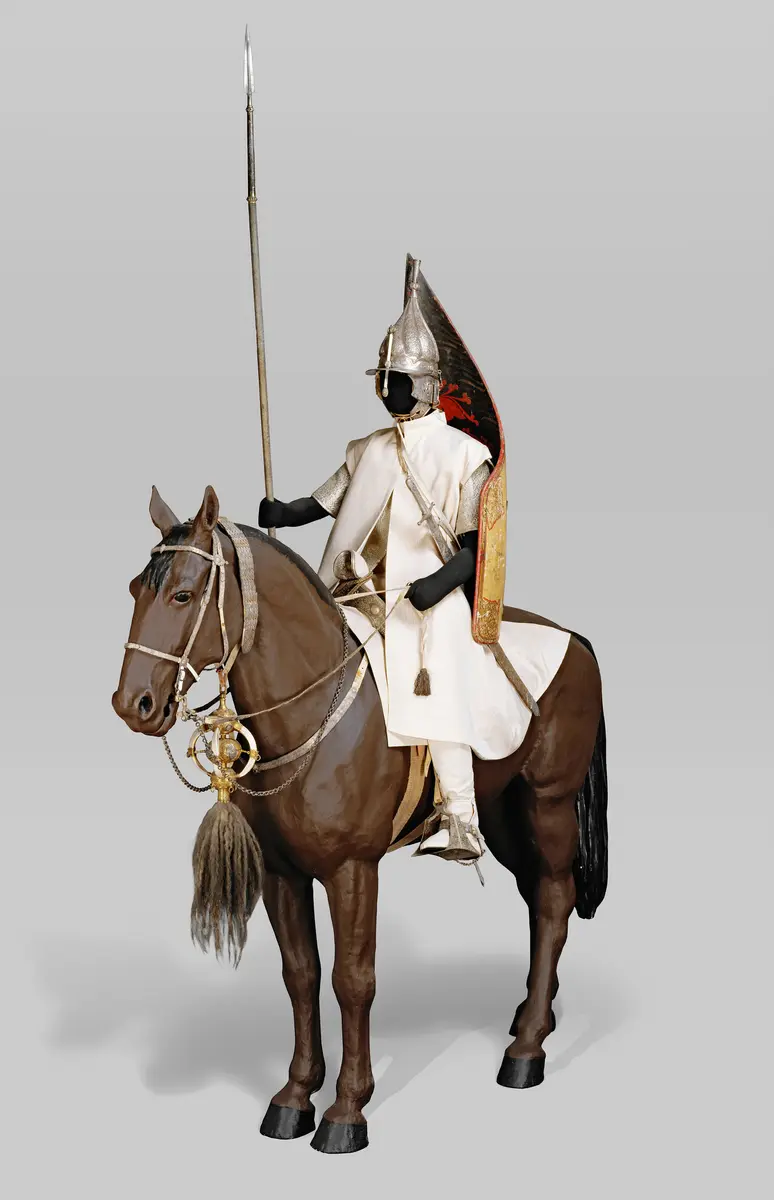
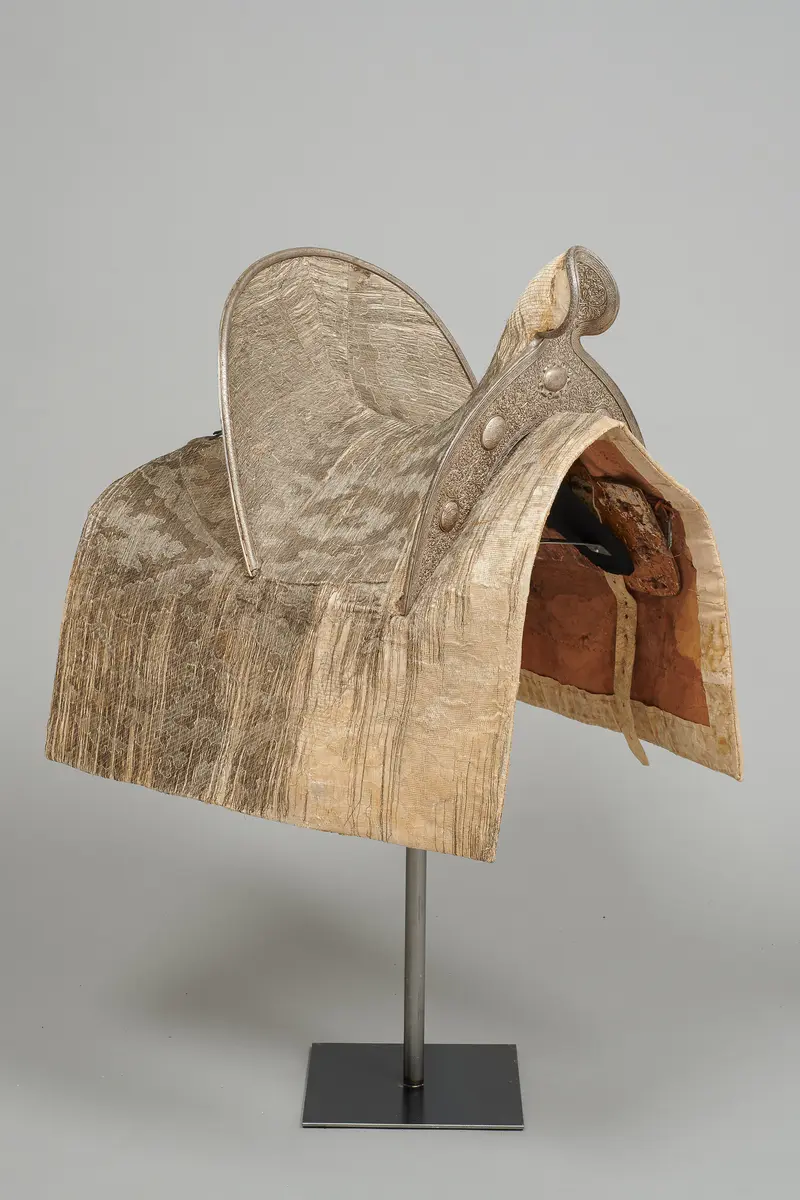
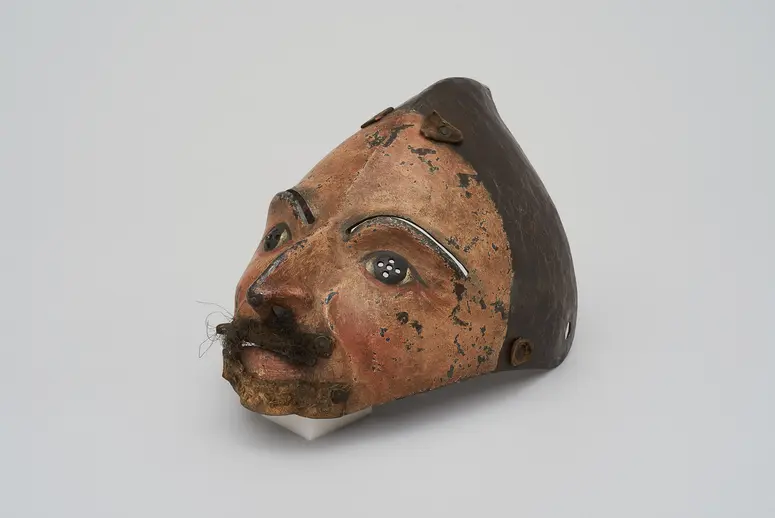
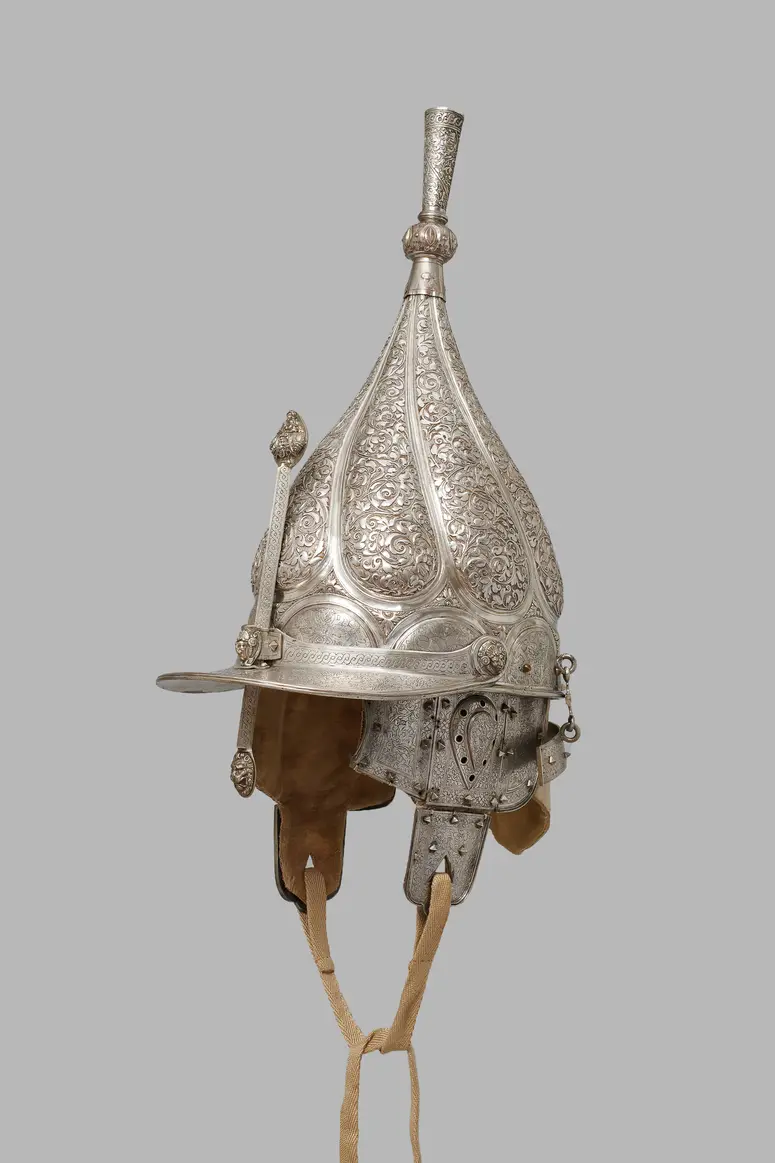
Sadly, the levy on silver imposed in 1809 to pay the contributions to the French army demanded by Napoleon resulted in catastrophic losses of art, not least in the Imperial Armoury. Francis I, Emperor of Austria, raided the imperial collections, among others the armoury, to raise the required sum, which is why only parts of the Silver Hussar’s Armour have survived. Originally it included a shield (lost), a burgonet, a silver bridle (mainly lost), a saddle with silver ornaments, a sword, a pair of stirrups (lost), spurs, and a lance holder. However, most of the rider’s clothes, made of silk and silver thread, survive: a coat, a short-sleeved jerkin, hose, and shoes.
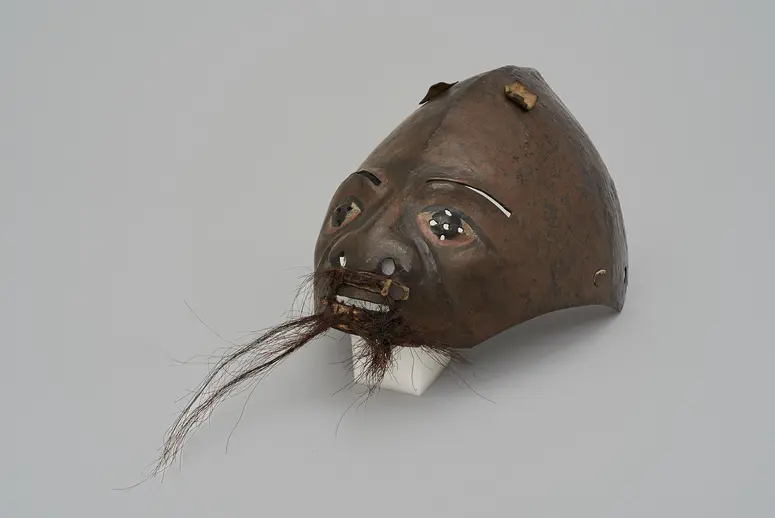
Today, the armour is displayed with a wooden shield (inv. B 195) and a wuntchuk (an equine decoration that dangles from the horse’s neck) that once also belonged to Archduke Ferdinand II (inv. C 149); the wuntchuk comprises gilt silver, the fangs of a wild boar, and animal hair.
Hussar tournaments were fought in disguise, with participants entering the lists dressed as European or Islamic warriors. We know that such tournaments were organized in Spain and Italy, and that Ferdinand II, Archduke of Austria, also hosted them during his tenure as regent of Bohemia (1547–67). Ferdinand’s hussar tournaments were political spectacles staged by the Habsburg court that reflected the very real military threat posed by the Ottoman Empire. However, we must also see them in the context of the chivalrous romances popular in the sixteenth century; these stories of heroes and heroines, bravery and chivalry, for instance Lodovico Ariosto’s Orlando Furioso (first published in Ferrara in 1532), celebrated not only Christian but also Muslim protagonists as honourable, chivalrous knights.
Sadly, the levy on silver imposed in 1809 to pay the contributions to the French army demanded by Napoleon resulted in catastrophic losses of art, not least in the Imperial Armoury. Francis I, Emperor of Austria, raided the imperial collections, among others the armoury, to raise the required sum, which is why only parts of the Silver Hussar’s Armour have survived. Originally it included a shield (lost), a burgonet, a silver bridle (mainly lost), a saddle with silver ornaments, a sword, a pair of stirrups (lost), spurs, and a lance holder. However, most of the rider’s clothes, made of silk and silver thread, survive: a coat, a short-sleeved jerkin, hose, and shoes.
Today, the armour is displayed with a wooden shield (inv. B 195) and a wuntchuk (an equine decoration that dangles from the horse’s neck) that once also belonged to Archduke Ferdinand II (inv. C 149); the wuntchuk comprises gilt silver, the fangs of a wild boar, and animal hair.
Owner:
Ferdinand II. (1564-1595), Erzherzog von Österreich und Landesherr von Tirol (1529 - 1595) DNB
Time:
1556 - 1557
Object Name
Die "Silberne Husarische Rüstung"
Culture
Süddeutsch
Dimensions:
mit Pferd: H 335 cm, L 229 cm, B 68 cm
Copyright
Kunsthistorisches Museum, Hofjagd- und Rüstkammer
Invs.
Hofjagd- und Rüstkammer, A 878
Browse more
Similar items you might be interested in
Ferdinand II. (1564-1595), Erzherzog von Österreich und Landesherr von Tirol um 1555
Ferdinand II. (1564-1595), Erzherzog von Österreich und Landesherr von Tirol 1557
Ferdinand II. (1564-1595), Erzherzog von Österreich und Landesherr von Tirol 1556-1557