Das Szepter
1615 datiert | Andreas Osenbruck
Early records state that the shaft of the present sceptre was turned from the legendary "alicorn", i.e., the horn of a unicorn. In reality, however, it is made from the tusk of a narwhal. According to legend, the unicorn could not be captured by a hunter but it placed its head in the lap of a virgin and allowed itself to be caught by her. In an extension of this myth, the maiden became the Virgin Mary, and the unicorn, which in the legend purified a poisoned well with its horn, was considered to be an image of Christ. Because of this symbolism with its reference to the power of Christ, this precious material was predestined to be a symbol of ecclesiastical and secular power. The slender shaft of the Sceptre is reinforced by an iron bar on the inside to prevent deformation by the heavy sceptre head of enamelled gold. This knob-like structure consists of curved clasps whose great variety of forms at first seems almost unintelligible to the eye. The choice of precious stones is a reference to the Rudolphine Crown (Inv. No. SK_WS_XIa_1). Six layers of ornamentation lie beneath the bezel settings of the main diamond clasps. The ruby clasps are designed slightly more simply. Similar to the Crown and Imperial Orb, a large sapphire serves as the crowning ornament of the Sceptre. The capsule at the end of the handle bears the signature of the goldsmith: "Andreas Osenbruck fecitt Anno 1615". For his crown, Rudolph II had still used the insignia of Emperor Ferdinand I from the 1530s. However, when Rudolph's brother and successor, Emperor Matthias (1557-1619), came to power, these were replaced by the new Sceptre by Andreas Osenbruck, who probably also created the matching Imperial Orb. In its form the Sceptre resembles a mace rather than its simple predecessors and represents a unique virtuoso example of the goldsmith's art.
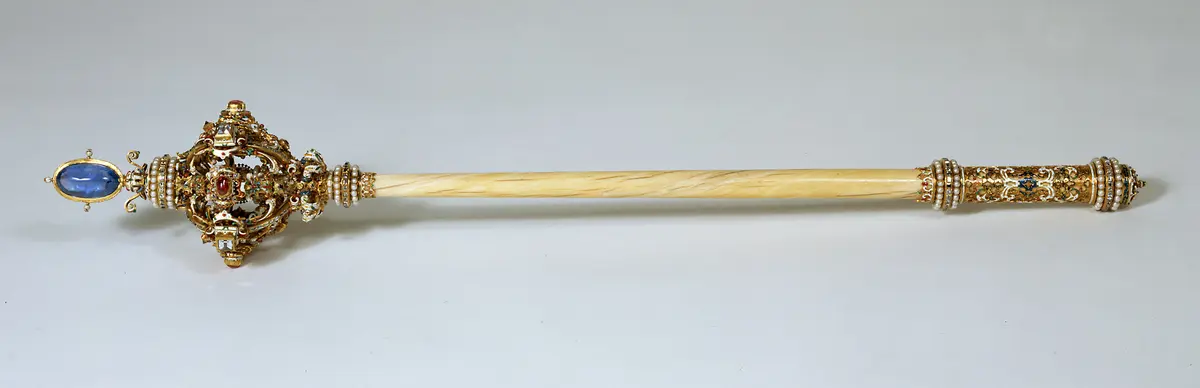
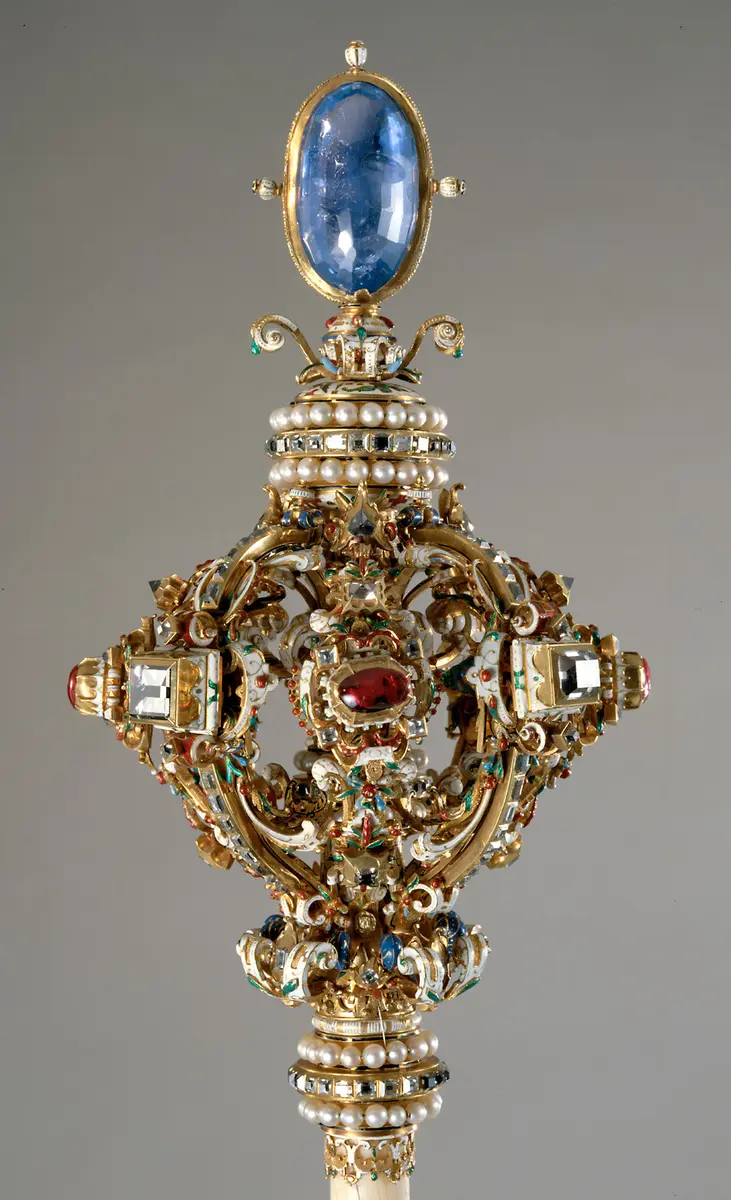
Early records state that the shaft of the present sceptre was turned from the legendary "alicorn", i.e., the horn of a unicorn. In reality, however, it is made from the tusk of a narwhal. According to legend, the unicorn could not be captured by a hunter but it placed its head in the lap of a virgin and allowed itself to be caught by her. In an extension of this myth, the maiden became the Virgin Mary, and the unicorn, which in the legend purified a poisoned well with its horn, was considered to be an image of Christ. Because of this symbolism with its reference to the power of Christ, this precious material was predestined to be a symbol of ecclesiastical and secular power. The slender shaft of the Sceptre is reinforced by an iron bar on the inside to prevent deformation by the heavy sceptre head of enamelled gold. This knob-like structure consists of curved clasps whose great variety of forms at first seems almost unintelligible to the eye. The choice of precious stones is a reference to the Rudolphine Crown (Inv. No. SK_WS_XIa_1). Six layers of ornamentation lie beneath the bezel settings of the main diamond clasps. The ruby clasps are designed slightly more simply. Similar to the Crown and Imperial Orb, a large sapphire serves as the crowning ornament of the Sceptre. The capsule at the end of the handle bears the signature of the goldsmith: "Andreas Osenbruck fecitt Anno 1615". For his crown, Rudolph II had still used the insignia of Emperor Ferdinand I from the 1530s. However, when Rudolph's brother and successor, Emperor Matthias (1557-1619), came to power, these were replaced by the new Sceptre by Andreas Osenbruck, who probably also created the matching Imperial Orb. In its form the Sceptre resembles a mace rather than its simple predecessors and represents a unique virtuoso example of the goldsmith's art.
Artist:
Andreas Osenbruck (tätig in Prag um 1610 - nach 1622) DNB
Time:
1615 datiert
Object Name
Insigne
Culture
Prag
Material/technology:
Ainkhürn (Narwalzahn), Gold, teilweise emailliert, Diamanten, Rubine, Saphir, Perlen
Dimensions:
L. 75,5 cm, Gewicht 1640 g
Signed
ANDREAS OSENBRVCK fecitt Anno 1615
Inscribed
"MATTHIAS 1612"
Copyright
Kunsthistorisches Museum, Weltliche Schatzkammer
Invs.
Schatzkammer, WS XIa 2