Das Schweißtuch der Veronika; Vera Icon
1617, um 1721
The sudarium of St. Veronica was once regarded as "one of the most precious relics belonging to the Imperial and Royal Ecclesiastical Treasury and the Imperial Residency of Vienna" (Catalogue of 1856). The princely family of Savelli had preserved this relic in their palace in Rome for generations and exhibited it annually for veneration during Easter week. According to a tradition, Valusian Savelli, an official at the court of Emperor Tiberius, had been given the sudarium by St. Veronica and brought it from Palestine to Rome. When the dynasty died out wit Giulio Savelli, his widow, Princess Catarina Giustiniana Savelli, presented the relic to Emperor Karl VI at a solemn ceremony in 1720. The sudarium was transferred from Rome to Vienna in 1721. As other relics of this kind existed it was assumed that Veronica had folded the cloth into three and that Christ's blood had soaked into all three layers. The Church had therefore authenticated three Holy Sudaria, among them this one. It is partly covered with gilded copper foil, shaped to accommodate the outline of the facial image. In an inscription dated 1617, Pope Paul V (1605-1621) forbade reproduction of the sudarium upon pain of excommunication. The ebony frame was probably made in Rome in 1617, while the outer silver frame set with cameos was added in Vienna in 1721 to replace a damaged copper frame. The sudarium itself has not yet been subjected to scientific examination.
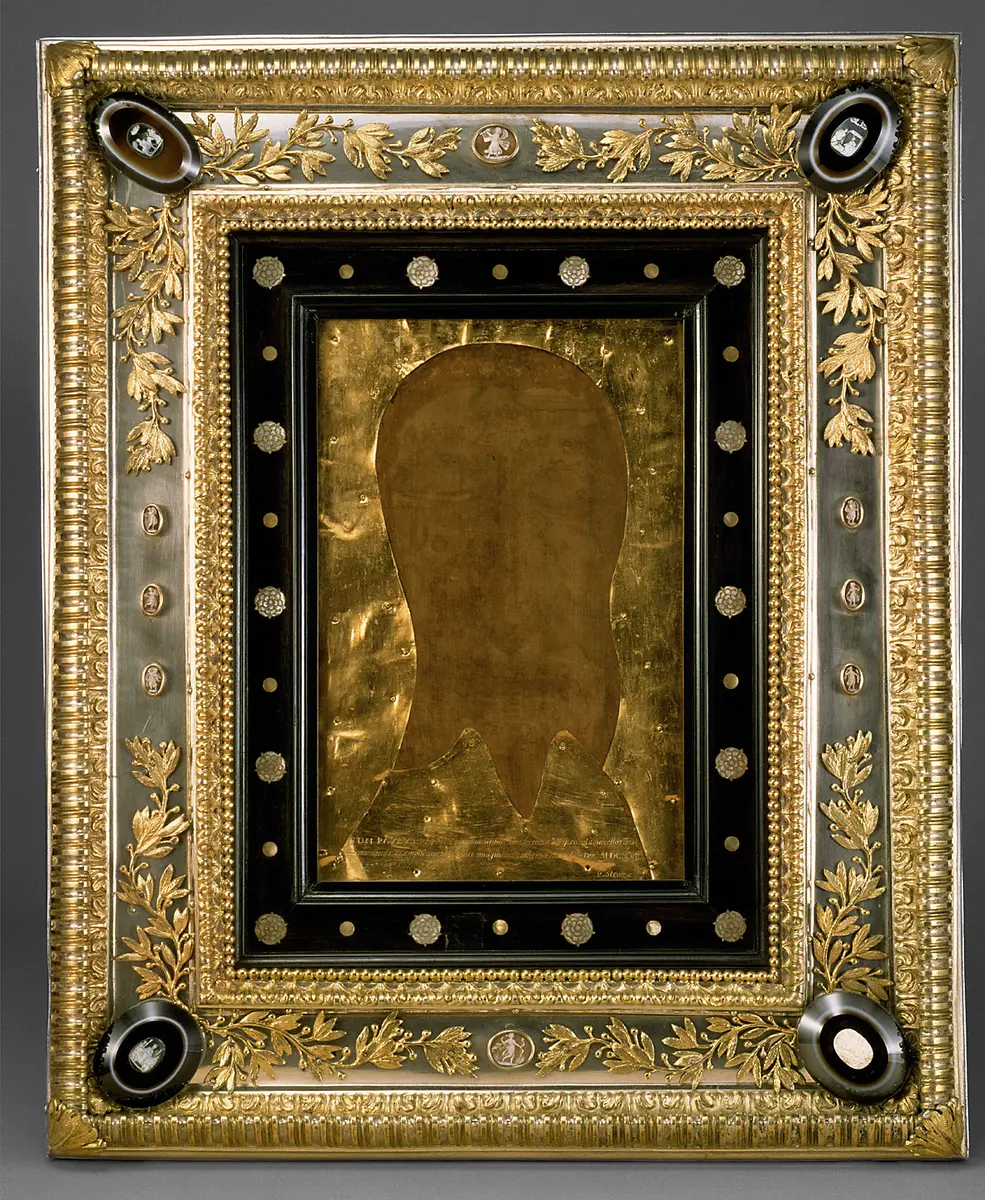
The sudarium of St. Veronica was once regarded as "one of the most precious relics belonging to the Imperial and Royal Ecclesiastical Treasury and the Imperial Residency of Vienna" (Catalogue of 1856). The princely family of Savelli had preserved this relic in their palace in Rome for generations and exhibited it annually for veneration during Easter week. According to a tradition, Valusian Savelli, an official at the court of Emperor Tiberius, had been given the sudarium by St. Veronica and brought it from Palestine to Rome. When the dynasty died out wit Giulio Savelli, his widow, Princess Catarina Giustiniana Savelli, presented the relic to Emperor Karl VI at a solemn ceremony in 1720. The sudarium was transferred from Rome to Vienna in 1721. As other relics of this kind existed it was assumed that Veronica had folded the cloth into three and that Christ's blood had soaked into all three layers. The Church had therefore authenticated three Holy Sudaria, among them this one. It is partly covered with gilded copper foil, shaped to accommodate the outline of the facial image. In an inscription dated 1617, Pope Paul V (1605-1621) forbade reproduction of the sudarium upon pain of excommunication. The ebony frame was probably made in Rome in 1617, while the outer silver frame set with cameos was added in Vienna in 1721 to replace a damaged copper frame. The sudarium itself has not yet been subjected to scientific examination.
Time:
1617, um 1721
Object Name
Reliquiar
Culture
Rom (?), 1616 und Wien, nach 1721 (Silberrahmen)
Material/technology:
Kupfer, vergoldet, Ebenholz, Perlmutter, Silber, teilweise vergoldet, Onxykameen, Kameen
Dimensions:
H. 39 cm, B. 28 cm
H. 59,5 cm, B. 48 cm
Inscribed
"S(UB) D(OMINUS) N(OSTRUM) PAULUS PAPA V. PRAESUMENTIBUS SINE LICENTIA AB IPSO VEL SUCCESORIBUS CONCEDENDA EXEMPLUM SUMERE HUIUS IMAGINIS ANATHEMA DIXIT ANNO DOMINI MDCXVII. P. STROZA"
Stamp / markings
Wr. Repunze 1806/07; Wr. Befr. stempel 1809/10
Copyright
Kunsthistorisches Museum, Geistliche Schatzkammer
Invs.
Schatzkammer, GS D 108