Celsusbibliothek
113 - 117 n. Chr.
The Library of Celsus occupied one of the most prominent locations in the ancient city: it was situated at the bottom end of the Curetes Street (embolos), which, as an ancient processional route, did not follow the grid of streets of the Hellenistic city. The two-storey façade with its sixteen columns made of pavonazzetto marble – one of the most expensive types of stone known in antiquity – and its aediculae, alcoves, sculptures and inscriptions represents a highpoint of architecture in Ephesus. Three entrances led into the library, which housed scrollswith literary works and many archival texts connected to the city. The crypt of the donor, Tiberius Iulius Celsus Polemaeanus, was located beneath a niche on the back wall. Burials within city limits were normally forbidden for religious and hygienic reasons, and exceptions from this rule were a mark of high favour. The closed marble sarcophagus must have been in place before the walls were erected, making the date of Celsus’ death an important chronological clue for the dating of the library. Celsus served as Proconsul of the Province of Asia; before that he was curator operum publicorum, i.e. responsible for Rome’s buildings. Perhaps Trajan’s Forum in Rome, where the emperor planned to be buried in the base of his column erected between two libraries, served as the inspiration for the project later realized at Ephesus. During an earthquake – probably in the third century ad – the library was destroyed and subsequently abandoned. Ist façade, however, remained standing. New statues, repurposedfrom other buildings, were placed in its niches, and reliefs from the so-called Parthian Monument (on show on the lower floor) were arranged as a basin in front of the outside staircase, turning the former library into a street fountain. In the 1970s, the façade of the Library of Celsus was reconstructed in an anastylosis using numerous extant ancient building components, becoming a landmark of the ancient city of Ephesus and a symbol of Rome in Asia Minor.
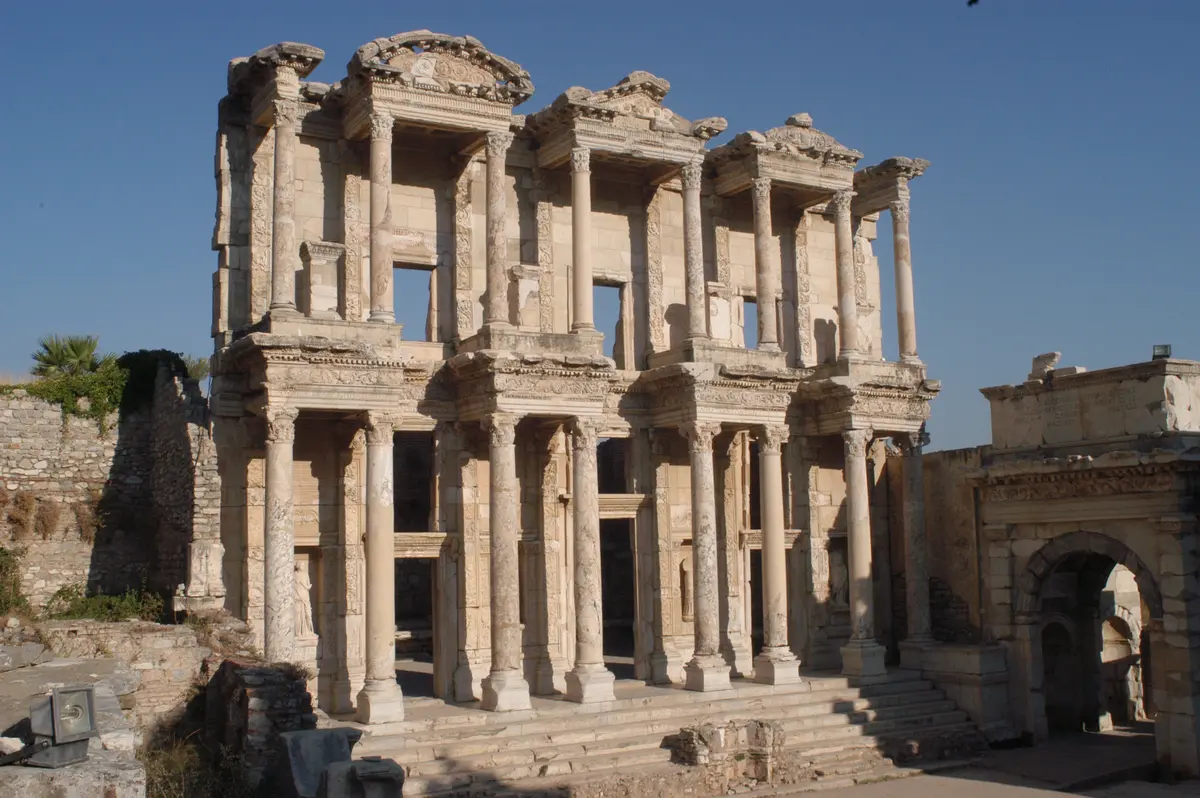
The Library of Celsus occupied one of the most prominent locations in the ancient city: it was situated at the bottom end of the Curetes Street (embolos), which, as an ancient processional route, did not follow the grid of streets of the Hellenistic city. The two-storey façade with its sixteen columns made of pavonazzetto marble – one of the most expensive types of stone known in antiquity – and its aediculae, alcoves, sculptures and inscriptions represents a highpoint of architecture in Ephesus. Three entrances led into the library, which housed scrollswith literary works and many archival texts connected to the city. The crypt of the donor, Tiberius Iulius Celsus Polemaeanus, was located beneath a niche on the back wall. Burials within city limits were normally forbidden for religious and hygienic reasons, and exceptions from this rule were a mark of high favour. The closed marble sarcophagus must have been in place before the walls were erected, making the date of Celsus’ death an important chronological clue for the dating of the library. Celsus served as Proconsul of the Province of Asia; before that he was curator operum publicorum, i.e. responsible for Rome’s buildings. Perhaps Trajan’s Forum in Rome, where the emperor planned to be buried in the base of his column erected between two libraries, served as the inspiration for the project later realized at Ephesus. During an earthquake – probably in the third century ad – the library was destroyed and subsequently abandoned. Ist façade, however, remained standing. New statues, repurposedfrom other buildings, were placed in its niches, and reliefs from the so-called Parthian Monument (on show on the lower floor) were arranged as a basin in front of the outside staircase, turning the former library into a street fountain. In the 1970s, the façade of the Library of Celsus was reconstructed in an anastylosis using numerous extant ancient building components, becoming a landmark of the ancient city of Ephesus and a symbol of Rome in Asia Minor.
Time:
113 - 117 n. Chr.
Object Name
Architektur
Culture
Römisch
Copyright
Kunsthistorisches Museum, Antikensammlung
Invs.
Antikensammlung, I Celsusbibliothek