Artemis
4. Jh. v. Chr.
The small woman’s head from the 4th century B. C., repeats in its execution the small eyes and mouth with the slightly upturned corners, the tradition of Cypriot sculpture from the 5th century B. C. However the full face is animated with a finer feeling for form. The hair is richly carved. Above the forehead the hair forms waves from the center parting. Two of the strands of hair which are pulled up above the ears, are joined together in a loop on the crown of the head. The hair on the back of the head is divided by three partings and hangs down to the nape of the neck. The ears are decorated with long, three-part earrings. From the original painting, one cans still discern traces of red on the lips and the right eyebrow. On the back of the head are the remains of a staff-shaped object, probably a quiver, which suggests a head of an Artemis statue. This would correspond with complete examples found in the holy-places of Pyla. The cult of the Greek Goddess of the Hunt is discernible in Cyprus before the fifth century B. C. and was widespread in Hellenistic and Roman periods.
A. Bernhard-Walcher u. a., Die Sammlung zyprischer Antiken im KHM. Sammlungskataloge des KHM Bd. 2, Wien: 1999
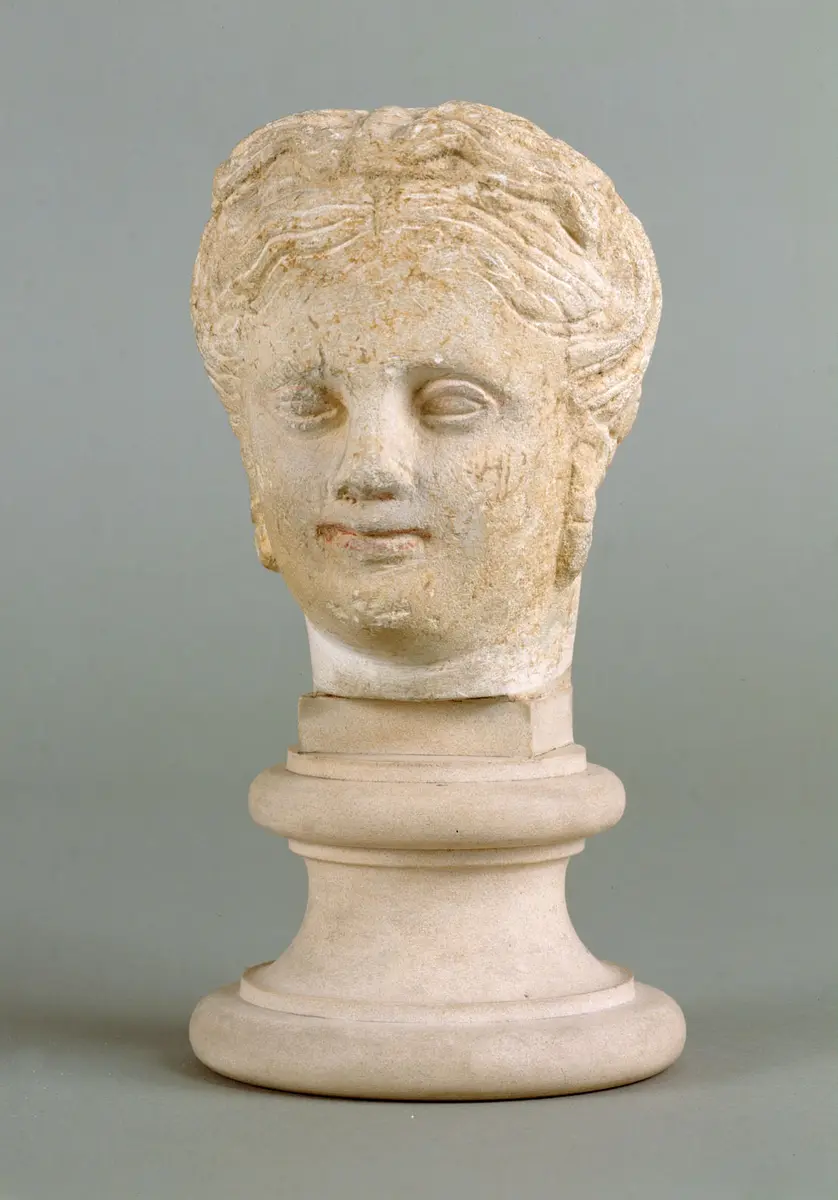
The small woman’s head from the 4th century B. C., repeats in its execution the small eyes and mouth with the slightly upturned corners, the tradition of Cypriot sculpture from the 5th century B. C. However the full face is animated with a finer feeling for form. The hair is richly carved. Above the forehead the hair forms waves from the center parting. Two of the strands of hair which are pulled up above the ears, are joined together in a loop on the crown of the head. The hair on the back of the head is divided by three partings and hangs down to the nape of the neck. The ears are decorated with long, three-part earrings. From the original painting, one cans still discern traces of red on the lips and the right eyebrow. On the back of the head are the remains of a staff-shaped object, probably a quiver, which suggests a head of an Artemis statue. This would correspond with complete examples found in the holy-places of Pyla. The cult of the Greek Goddess of the Hunt is discernible in Cyprus before the fifth century B. C. and was widespread in Hellenistic and Roman periods.
A. Bernhard-Walcher u. a., Die Sammlung zyprischer Antiken im KHM. Sammlungskataloge des KHM Bd. 2, Wien: 1999
Time:
4. Jh. v. Chr.
Object Name
Kopf
Culture
Zyprisch
Location of discovery:
Idalion (Dhali, Zypern)
Material/technology:
Kalkstein; Reste von roter Bemalung
Dimensions:
H. 11,8 cm
Copyright
Kunsthistorisches Museum, Antikensammlung
Invs.
Antikensammlung, I 627
Provenance
Millosicz, Georg von, Wien; 1890 Kauf aus dem Nachlass