Allegory of the Earthly Pilgrimage
2nd quarter 16th c. | Joachim Forster
Autonome Kleinbronzen als Sammelobjekte in Gestalt von Statuetten und Plaketten begannen nördlich der Alpen erst nach 1500 eine Rolle zu spielen. Entsprechende Anregungen durch die italienische Renaissance wurden in dieser Frühzeit vor allem in Nürnberg und Augsburg aufgegriffen und mit lokalen Traditionen des Bronzegusses verbunden. Vielfach hatten die Arbeiten aber auch eine praktische Funktion als Schmuck von Möbeln, Türen oder Brunnen.
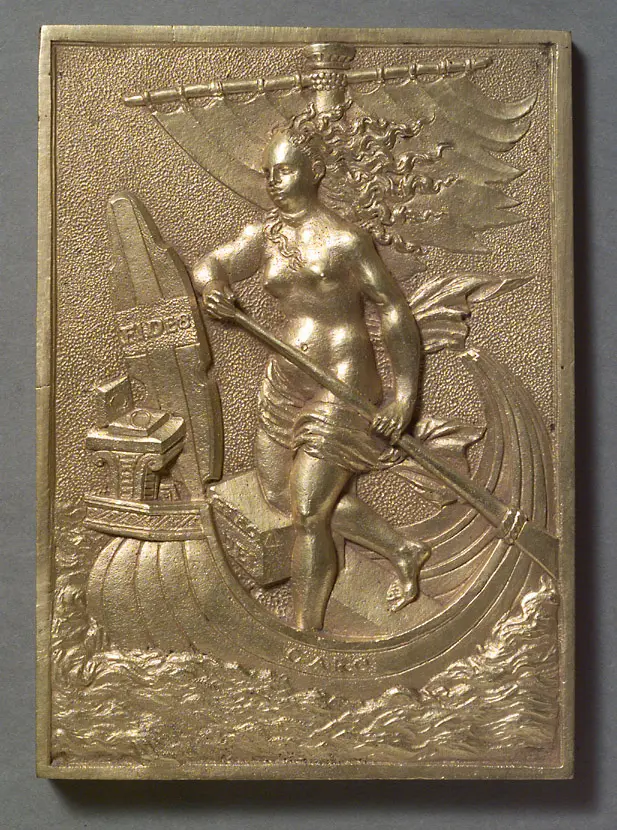
Autonome Kleinbronzen als Sammelobjekte in Gestalt von Statuetten und Plaketten begannen nördlich der Alpen erst nach 1500 eine Rolle zu spielen. Entsprechende Anregungen durch die italienische Renaissance wurden in dieser Frühzeit vor allem in Nürnberg und Augsburg aufgegriffen und mit lokalen Traditionen des Bronzegusses verbunden. Vielfach hatten die Arbeiten aber auch eine praktische Funktion als Schmuck von Möbeln, Türen oder Brunnen.
Attributed to:
Joachim Forster (um 1500 Augsburg - 1579 Augsburg)
Time:
2nd quarter 16th c.
Object Name
relief; plaque; bronze sculpture
Culture
Augsburg
Material/technology:
Gilded bronze
Dimensions:
13,6 cm × 9,8 cm × 1,2 cm
Inscribed
"CARO"; "FIDES"; "GRACIA DEI"
Copyright
Kunsthistorisches Museum, Kunstkammer
Invs.
Kunstkammer, 6043