Allegory of Salvation
after 1543 | Wolfgang Huber
The picture was created as a commission of the Prince Bishop of Passau, Wolfgang Graf von Salm, who is depicted kneeling in the foreground as patron. The allegory of salvation shows a comparison between the crucifixion of Christ and its „typological equivalent“ in the Old Testament, the raising of the bronze snake by Moses (Num 21,9). In the background: the healing by Peter and John of the man born lame (Acts 3,1-10), to the right the imprisonment of the Apostles (Acts 4,3).
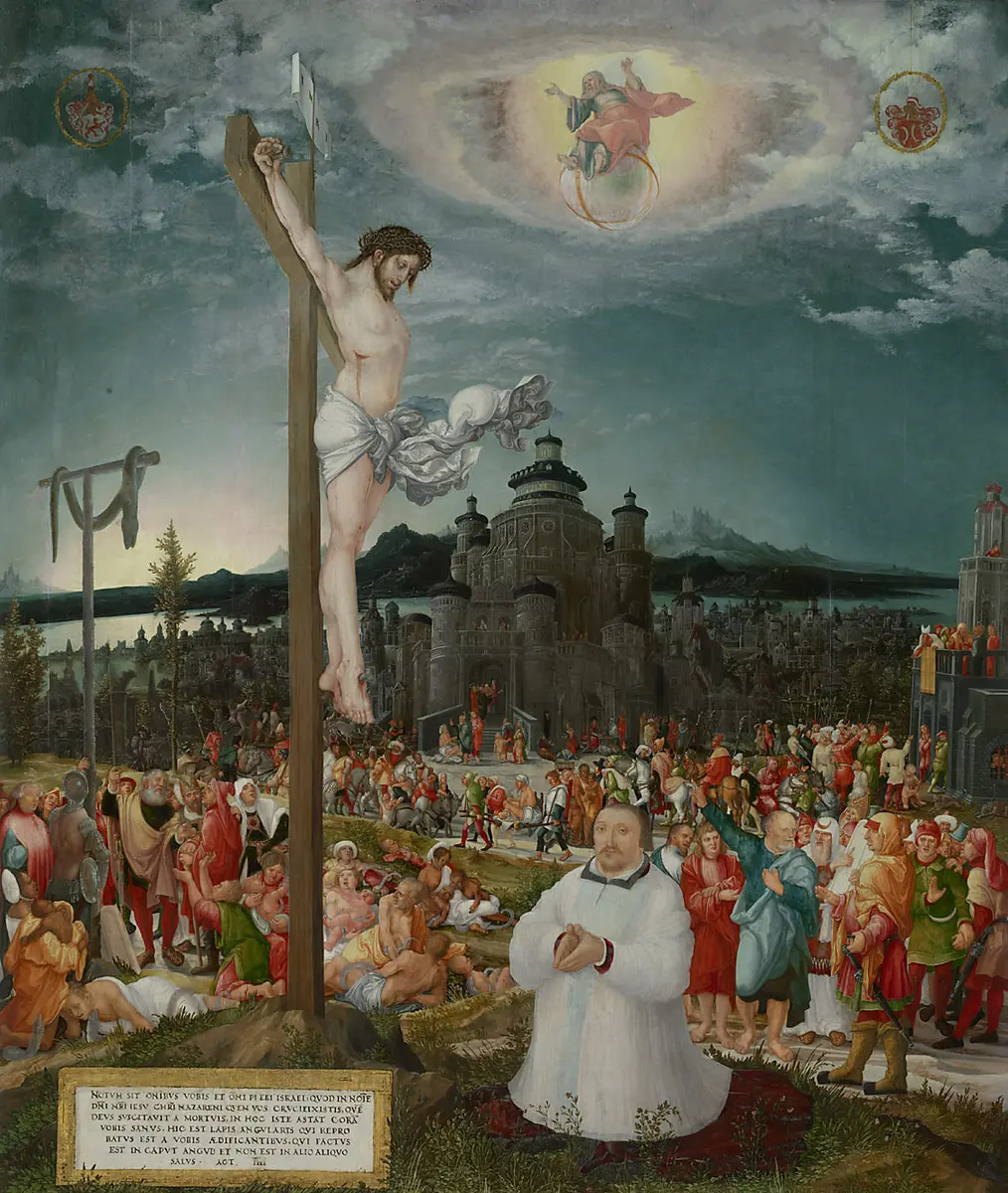
The picture was created as a commission of the Prince Bishop of Passau, Wolfgang Graf von Salm, who is depicted kneeling in the foreground as patron. The allegory of salvation shows a comparison between the crucifixion of Christ and its „typological equivalent“ in the Old Testament, the raising of the bronze snake by Moses (Num 21,9). In the background: the healing by Peter and John of the man born lame (Acts 3,1-10), to the right the imprisonment of the Apostles (Acts 4,3).
Artist:
Wolfgang Huber (1480 - 1553) DNB
Depiction/Person:
Wolfgang von Salm (1541 - 1555)
Time:
after 1543
Object Name
Painting
Culture
German
Material/technology:
Limewood
Dimensions:
154 x 130 cm
Framed: 176,5 cm × 153,5 cm × 6,5 cm
Inscribed
Oben links das Passauer Bistumswappen; rechst das Wappen des im Vordergrund knienden Stifters, Wolfgang I. Graf Salm, Fürstbischof von Passau; links unten eine Inschrifttafel mit einem Auszug der Rede des Apostels Petrus vor dem Hohen Rat: NOTVM SIT ONIBVS VOBIS ET ONI PLEBI ISRAEL: QVOD IN NOIE/DNI NRI IESV CHRI NAZARENI QVEM VOS CRVCIFIXISTIS, QVE/DEVS SUSCITAVIT A MORTVIS, IN HOC ISTE ASTAT CORA/VOBIS SANVS. HIC EST LAPIS ANGVLARIS QVI REPRO/BATVS EST A VOBIS AEDIFICANTIBVS, QVI FACTVS/EST IN CAPVT ANGVLI ET NON EST IN ALIO ALIQVO/SALVS. ACT IIII
Copyright
Kunsthistorisches Museum, Gemäldegalerie
Invs.
Gemäldegalerie, 971
Provenance
1783 documented in the gallery