All'antica-Sturmhaube
datiert 1532 | Francesco Maria I. della Rovere
This burgonet is the earliest known work by Filippo Negroli, an armourer from Milan, and the earliest Italian all’antica helmet from the sixteenth century. Negroli signed and dated the helmet in 1532, at the age of around 22. It bears witness to his skills and artistic maturity even at the onset of his career. Negroli is the only armourer included by Giorgio Vasari among the painters and sculptors he celebrated in his Lives of Artists (first published in Florence in 1550).
The helmet imitates a curly head of hair, turning the wearer into a classical hero. There are no direct templates for this helmet in Renaissance armour, and Negroli presumably based his design on ancient sculptures and coins or on descriptions and sketches of classical models. Contemporaries must have marvelled at his virtuoso handling and daring, innovative conception. The skull was forged from a single piece of iron, the bouncing curls appear lifelike. Drilled holes on the temples show that a laurel wreath could be fitted onto the headband in the shape of palm fronds. The cheek guards feature naturalistic chased ears, the earlobes of which have tiny holes for pendant earrings.
Negroli produced this helmet for Francesco Maria I della Rovere, the first Duke of Urbino from the della Rovere family, who served his uncle, Pope Julius II, as commander-in-chief of the papal army. In 1523, della Rovere took command of the Venetian army in the war against King Francis I of France.
Around 1580, the helmet was sent from Urbino as a gift to Ferdinand II, Archduke of Austria, for the collection the latter was assembling at Ambras Castle near Innsbruck. It had been dispatched to Innsbruck together with a cuirass made of mail and plate that Negroli had produced for Francesco Maria I della Rovere around 1532–35, which is also now in Vienna (inv. A 498).
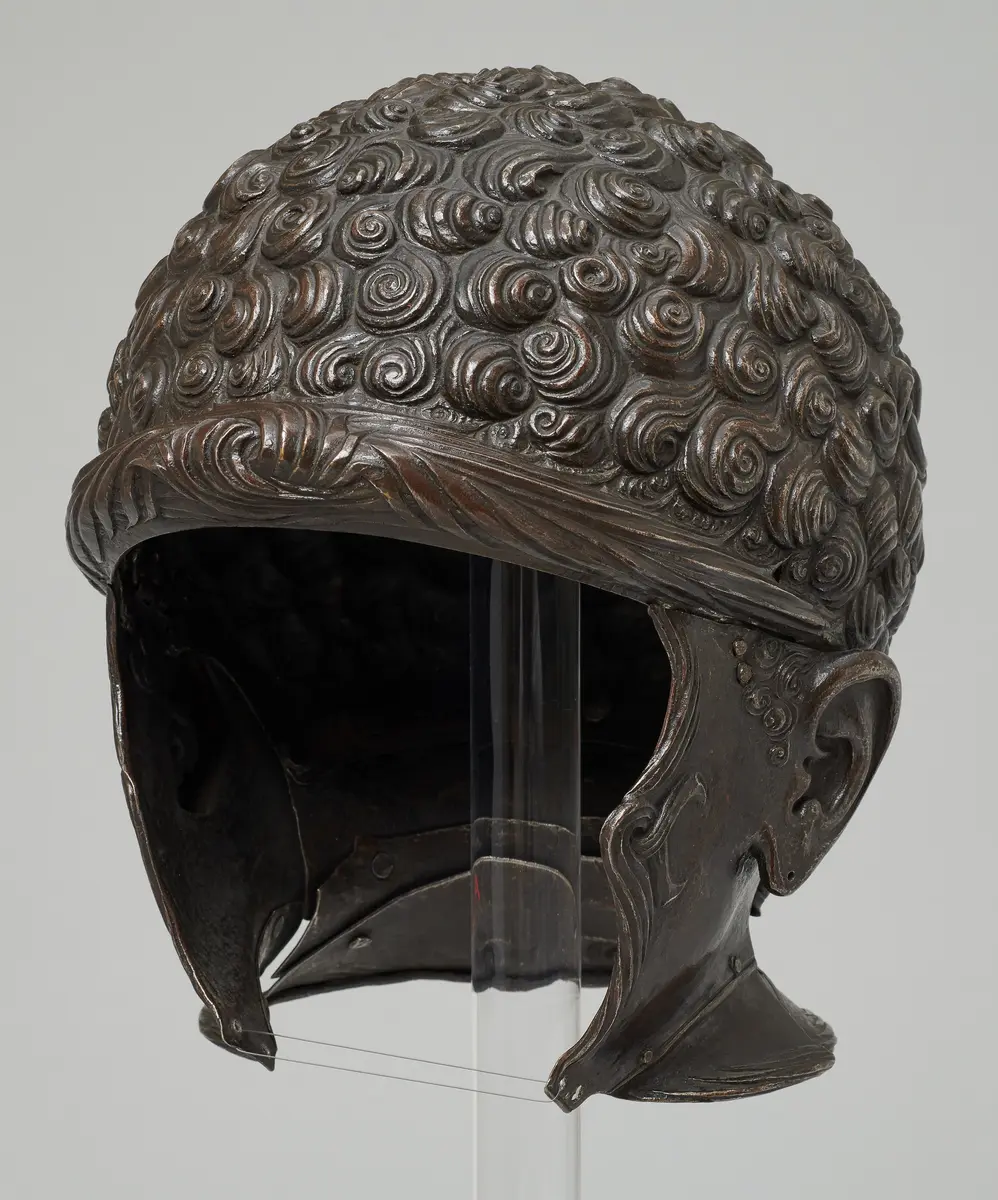
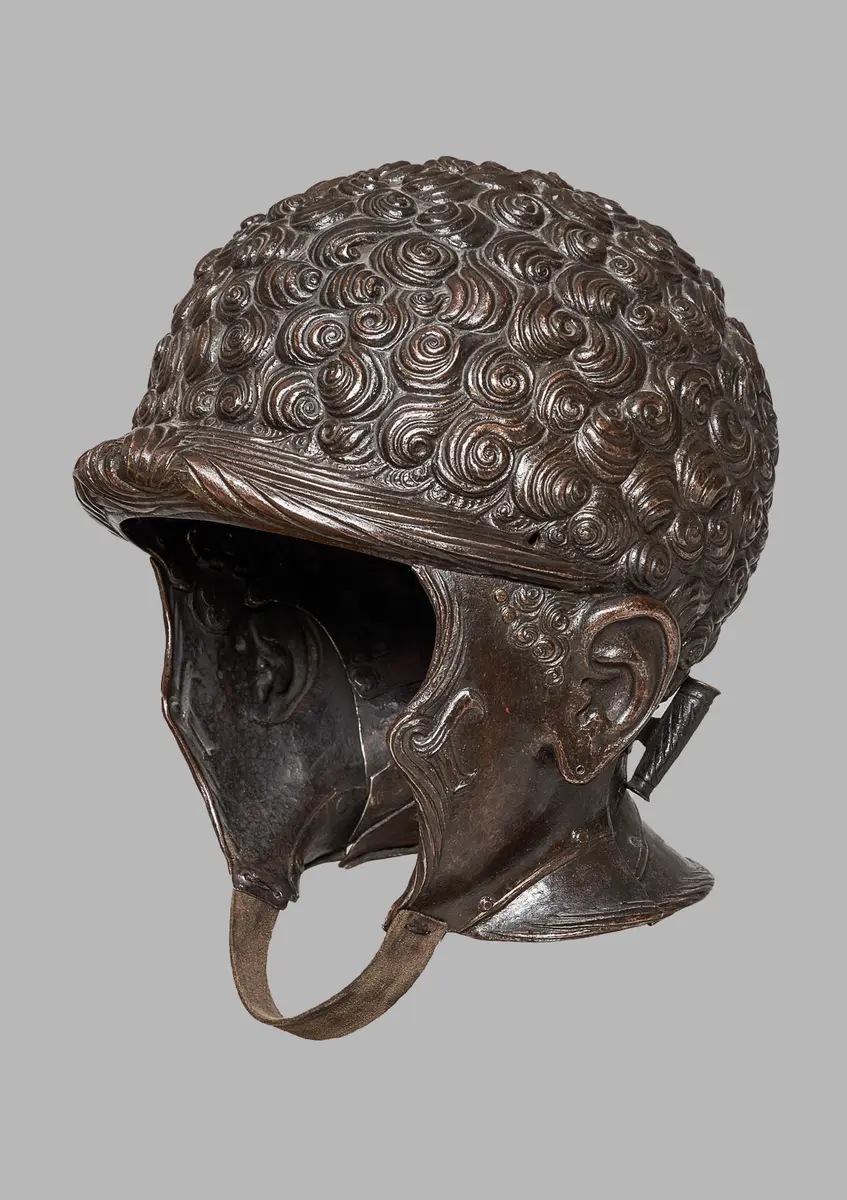
This burgonet is the earliest known work by Filippo Negroli, an armourer from Milan, and the earliest Italian all’antica helmet from the sixteenth century. Negroli signed and dated the helmet in 1532, at the age of around 22. It bears witness to his skills and artistic maturity even at the onset of his career. Negroli is the only armourer included by Giorgio Vasari among the painters and sculptors he celebrated in his Lives of Artists (first published in Florence in 1550).
The helmet imitates a curly head of hair, turning the wearer into a classical hero. There are no direct templates for this helmet in Renaissance armour, and Negroli presumably based his design on ancient sculptures and coins or on descriptions and sketches of classical models. Contemporaries must have marvelled at his virtuoso handling and daring, innovative conception. The skull was forged from a single piece of iron, the bouncing curls appear lifelike. Drilled holes on the temples show that a laurel wreath could be fitted onto the headband in the shape of palm fronds. The cheek guards feature naturalistic chased ears, the earlobes of which have tiny holes for pendant earrings.
Negroli produced this helmet for Francesco Maria I della Rovere, the first Duke of Urbino from the della Rovere family, who served his uncle, Pope Julius II, as commander-in-chief of the papal army. In 1523, della Rovere took command of the Venetian army in the war against King Francis I of France.
Around 1580, the helmet was sent from Urbino as a gift to Ferdinand II, Archduke of Austria, for the collection the latter was assembling at Ambras Castle near Innsbruck. It had been dispatched to Innsbruck together with a cuirass made of mail and plate that Negroli had produced for Francesco Maria I della Rovere around 1532–35, which is also now in Vienna (inv. A 498).
Owner:
Francesco Maria I. della Rovere (1490 - 1538) DNB
Artist:
Filippo Negroli (ca. 1510 - 1579, tätig in Mailand) DNB
Time:
datiert 1532
Object Name
All'antica-Sturmhaube
Culture
Mailand
Material/technology:
Eisen, geschmiedet, getrieben, brüniert, teils ziseliert, teils punziert. Textil (fragmentarisch erhalten). Leder (fragmentarisch erhalten).
Dimensions:
H 28 cm × B 21 cm × T 24,3 cm
Gewicht: 2,65 kg
Inscribed
im Nacken: "PHILIPPI NIGROLI IAC F / MEDIOLANENSIS OPVS / M D XXXII"
Stamp / markings
Marke am Hals, hinter dem rechten Ohr: zwei gekreuzte Schlussel, bekrönt
Copyright
Kunsthistorisches Museum, Hofjagd- und Rüstkammer
Invs.
Hofjagd- und Rüstkammer, A 498a