Tempietto mit Schmerzensmann
um 1613/20 | Christoph Angermair
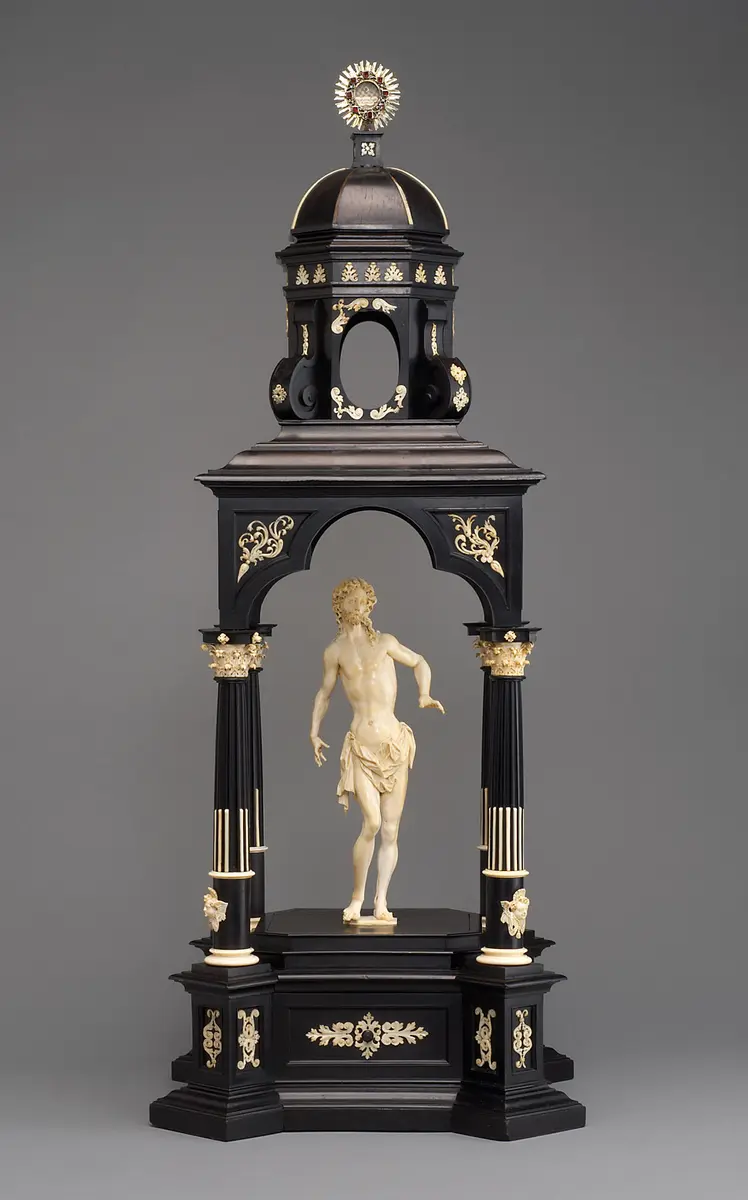
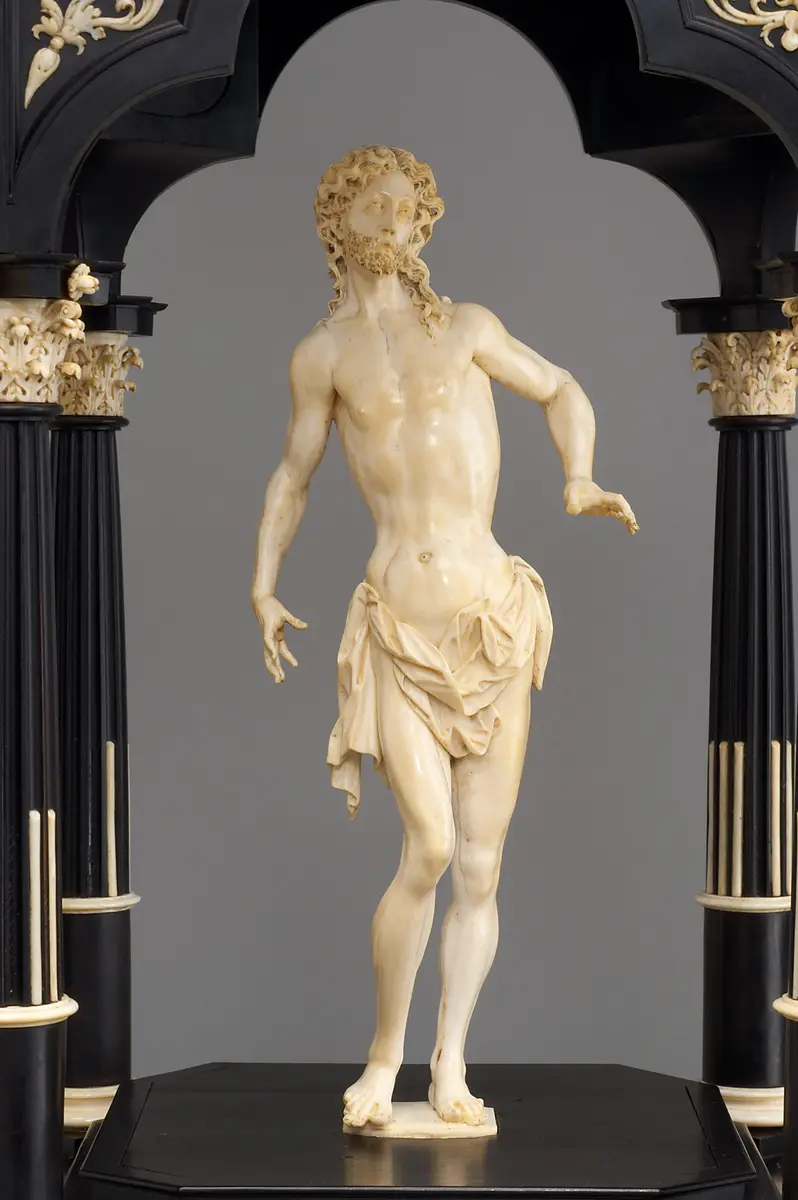
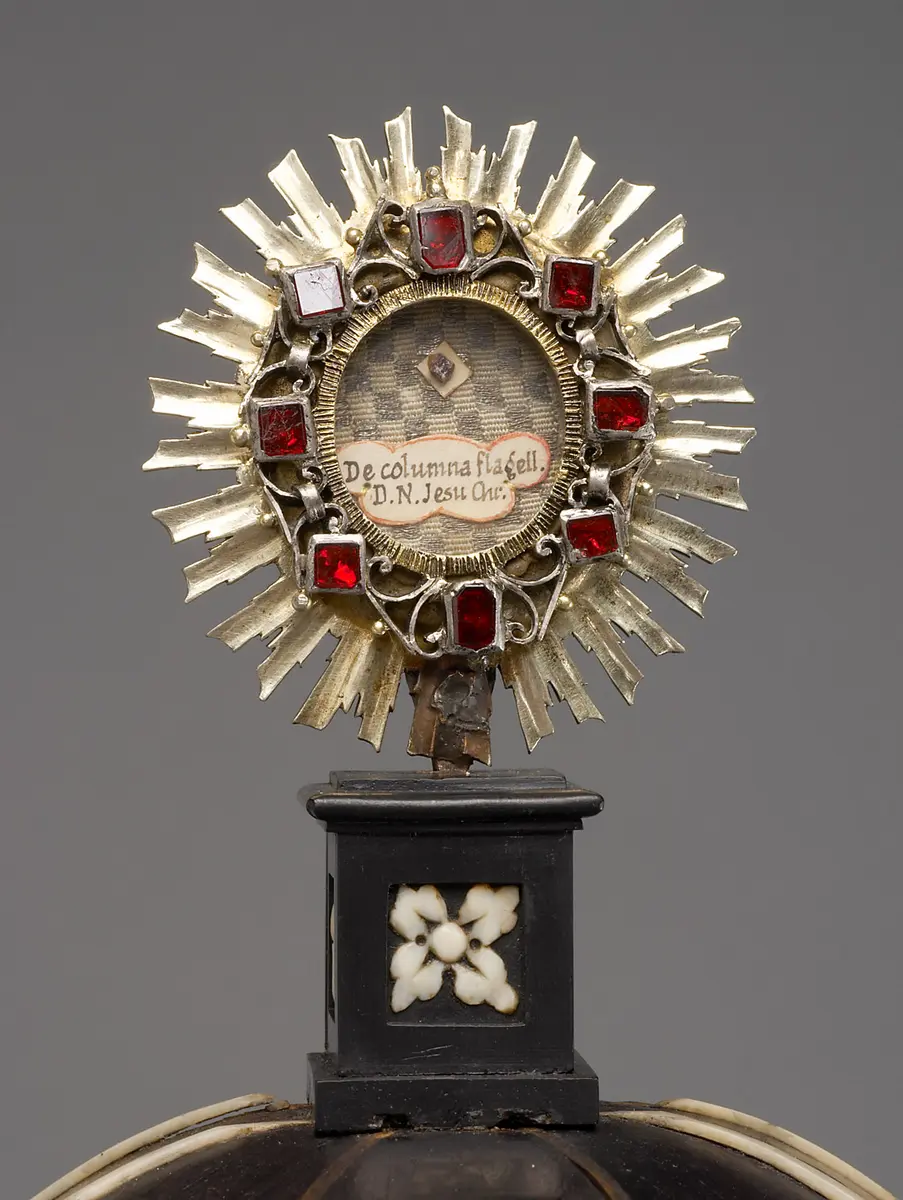
The square ebony baldachin with diagonally placed columns encloses an ivory figure of Christ as the Man of Sorrows. On the baldachin, volutes graduate into an octagonal domed superstructure with lateral oval openings. The crowning aureole of silver-gilt set with almandines - which supposedly contains a particle of die scourging column of Christ - was not added until 1922. The original relics were probably preserved in the socle of the tempietto, since two sides have drawers, today empty. The classification of the piece has until recently been hindered by the singular, almost "mannerist" figure of Christ, which was presumed to be of Spanish provenance. However the slender proportions, narrow pectoral girdle, protruding belly and rounded hips are characteristic of a late Gothic Man of Sorrows from the end of the l5th century. Similar interpretations are to be found in the graphic art, painting and sculpture of this period. However, as the individual motifs indicate, it is not a late Gothic statuette but a work by an ivory carver of the early l7th century, who had closely followed a late Gothic model (perhaps a venerated miracle-working image or a graphic model). Quite apart of the fascinating conception of the figure, the piece is notable for the technical brilliance of its carving. The stylistic idiosyncrasies o f the figure are also found in the works of the famous ivory carver from Munich, Christoph Angermair, to whom the statuette can be ascribed The tempietto is first documented in 1752, in the treasury of Capuchin Monastery.
The square ebony baldachin with diagonally placed columns encloses an ivory figure of Christ as the Man of Sorrows. On the baldachin, volutes graduate into an octagonal domed superstructure with lateral oval openings. The crowning aureole of silver-gilt set with almandines - which supposedly contains a particle of die scourging column of Christ - was not added until 1922. The original relics were probably preserved in the socle of the tempietto, since two sides have drawers, today empty. The classification of the piece has until recently been hindered by the singular, almost "mannerist" figure of Christ, which was presumed to be of Spanish provenance. However the slender proportions, narrow pectoral girdle, protruding belly and rounded hips are characteristic of a late Gothic Man of Sorrows from the end of the l5th century. Similar interpretations are to be found in the graphic art, painting and sculpture of this period. However, as the individual motifs indicate, it is not a late Gothic statuette but a work by an ivory carver of the early l7th century, who had closely followed a late Gothic model (perhaps a venerated miracle-working image or a graphic model). Quite apart of the fascinating conception of the figure, the piece is notable for the technical brilliance of its carving. The stylistic idiosyncrasies o f the figure are also found in the works of the famous ivory carver from Munich, Christoph Angermair, to whom the statuette can be ascribed The tempietto is first documented in 1752, in the treasury of Capuchin Monastery.
Artist:
Christoph Angermair (um 1580 Weilheim - 1633 München) DNB
Time:
um 1613/20
Object Name
Reliquiar; Statuette; Elfenbeinschnitzerei
Culture
München
Material/technology:
Elfenbein, Hartholz, Ebenholzauflagen, Silber vergoldet, Almandine
Dimensions:
H. 71,5 cm
Statuette : H. 26,2 cm
Copyright
Kunsthistorisches Museum, Geistliche Schatzkammer
Invs.
Schatzkammer, GS Kap 297