Kruzifix
Mitte 18. Jahrhundert | Gabriel Grupello
As Christ raises his eyes plaintively to heaven, his body seems to rear up in convulsive movement. The death agony on the cross is thus conveyed in a particularly moving way in this crucifix. The anatomy of the hanging body is depicted with numerous details, such as the plexus of veins on the upper belly, or the muscles on the breastbone. These are combined with the masterly carving of the hair, the crown of thorns and the loincloth, which enrich the figure without presupposing or prejudicing the success of the composition as a whole. This masterpiece is attributed to the Flemish sculptor Gabriel Gruppello, who enjoyed great esteem even in his own time. After 1695, he worked in Düsseldorf as the "Kabinettstatuarius" of the Prince Elector Johann Wilhelm of the Palatinate. This is probably the crucifix, which Gruppello presented to the future Emperor Karl V, when he later paid a visit to the artist's workshop while in Düsseldorf in 1703. The Museum für Kunst und Gewerbe in Hamburg is in possession of a wooden variation of this successful piece, and the tip of its loincloth, too, resembles "the leaf of a thistle abruptly withered in the sun" (L.L. Möller, Catalogue, Hamburg)
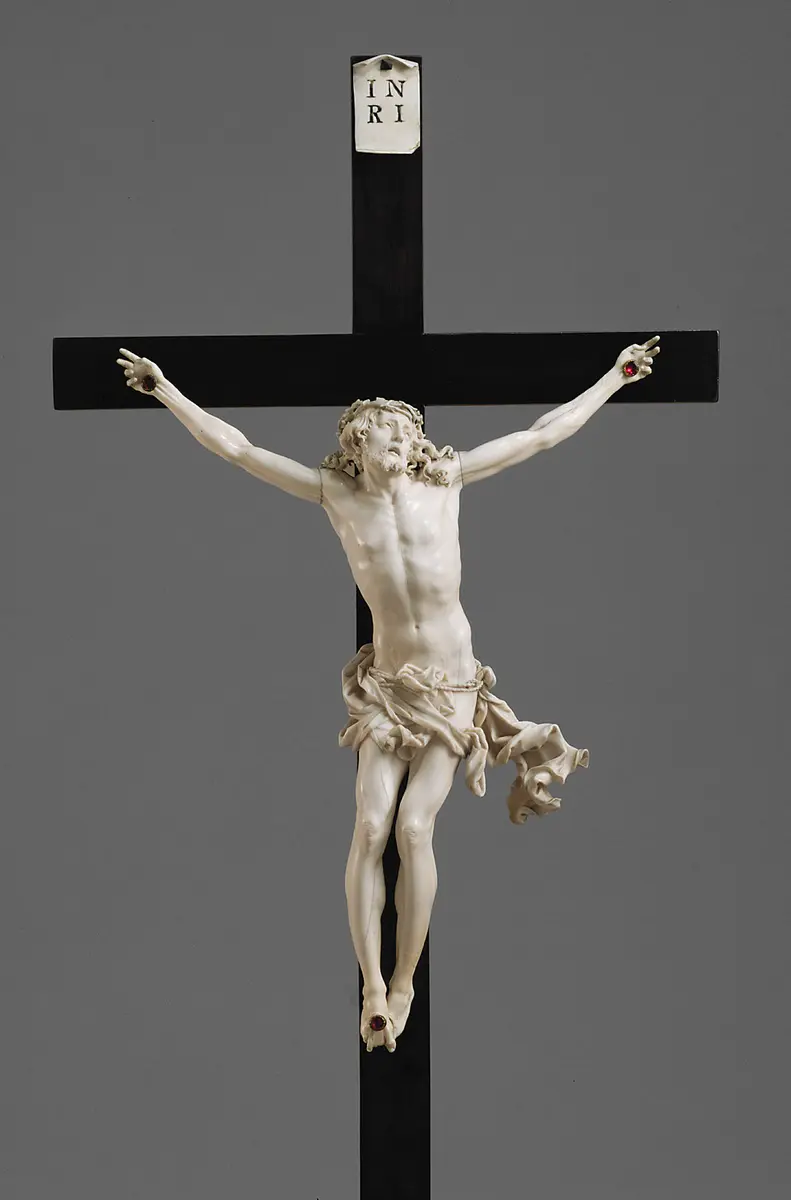
As Christ raises his eyes plaintively to heaven, his body seems to rear up in convulsive movement. The death agony on the cross is thus conveyed in a particularly moving way in this crucifix. The anatomy of the hanging body is depicted with numerous details, such as the plexus of veins on the upper belly, or the muscles on the breastbone. These are combined with the masterly carving of the hair, the crown of thorns and the loincloth, which enrich the figure without presupposing or prejudicing the success of the composition as a whole. This masterpiece is attributed to the Flemish sculptor Gabriel Gruppello, who enjoyed great esteem even in his own time. After 1695, he worked in Düsseldorf as the "Kabinettstatuarius" of the Prince Elector Johann Wilhelm of the Palatinate. This is probably the crucifix, which Gruppello presented to the future Emperor Karl V, when he later paid a visit to the artist's workshop while in Düsseldorf in 1703. The Museum für Kunst und Gewerbe in Hamburg is in possession of a wooden variation of this successful piece, and the tip of its loincloth, too, resembles "the leaf of a thistle abruptly withered in the sun" (L.L. Möller, Catalogue, Hamburg)
previously attributed to:
Gabriel Grupello (1644 Geraardsbergen - 1730 Ehrenstein/Kerkrade) DNB
Time:
Mitte 18. Jahrhundert
Object Name
Kruzifix; Elfenbeinschnitzerei
Culture
Italienisch (Rom?)
Material/technology:
Elfenbein, Glas, Hartholz, schwarz gebeizt
Dimensions:
H. 30,3 cm, B. 31,5 cm
Copyright
Kunsthistorisches Museum, Geistliche Schatzkammer
Invs.
Schatzkammer, GS E 46