Brosche mit Liebespaar
um 1430/40
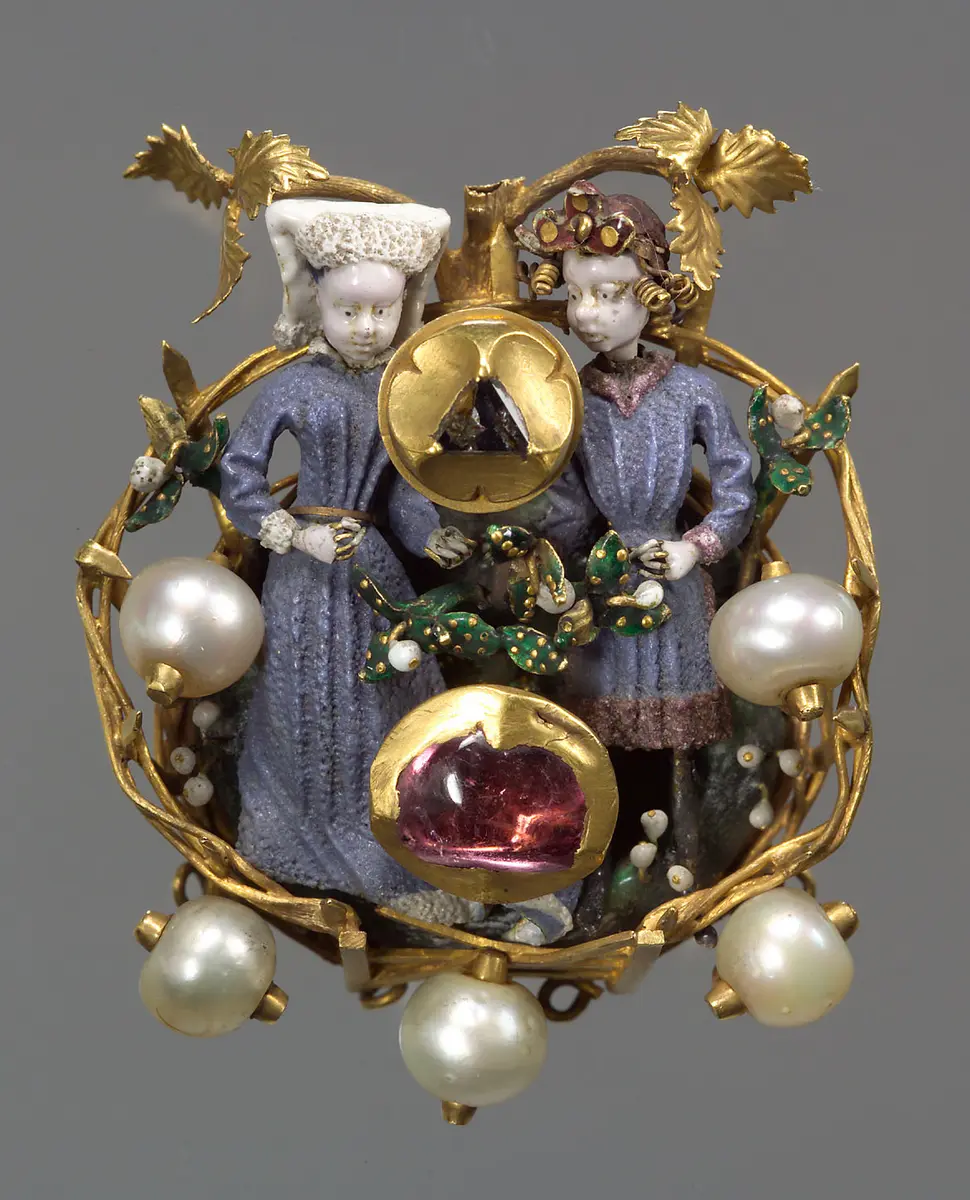
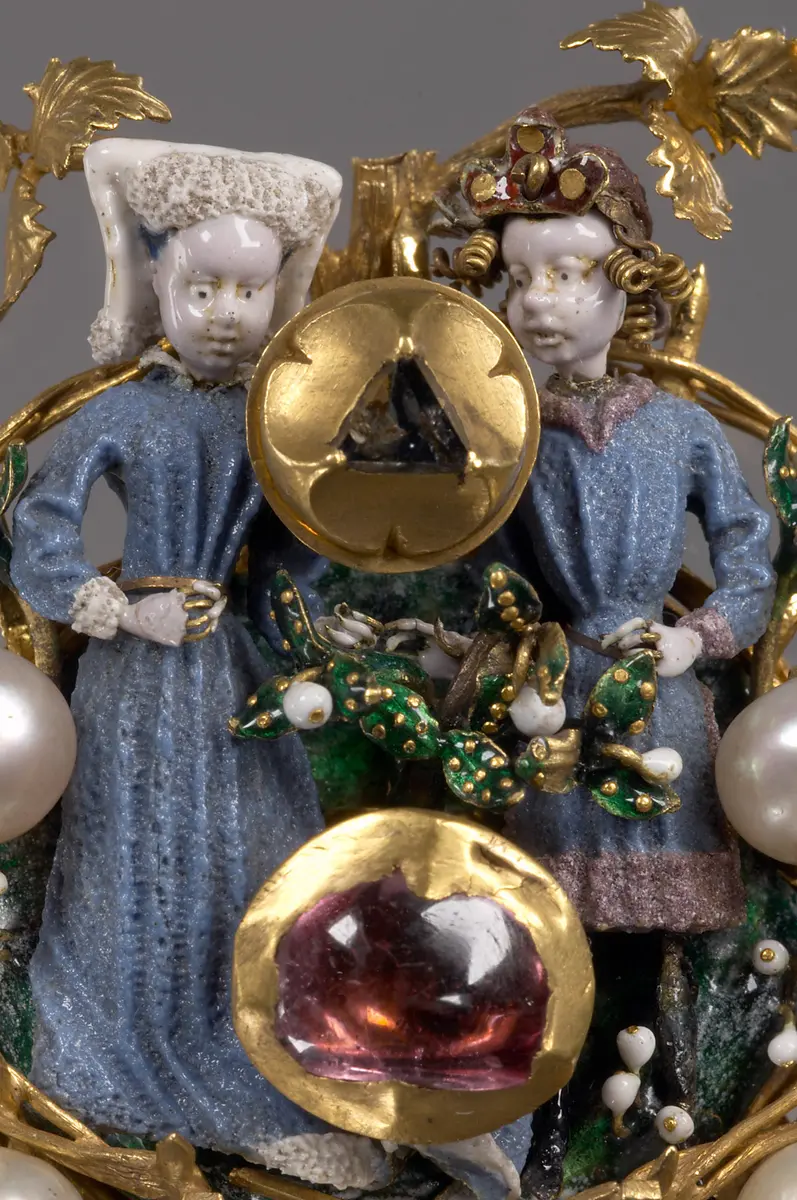
The brooch was first documented in the inventory of Emperor Ferdinand I and probably came into Habsburg possession through his grandmother, Archduchess Mary of Burgundy. The brooch depicts an aristocratic, fashionably dressed young couple enclosed in a love-garden by a fence in the shape of a wreath. They were once shaded by a tree, but the tree's crown, which was set with rubies and pendant pearls, was broken and has been lost. Gold enamel sculpture was one of the most sophisticated developments in courtly art around 1400. A new technique made it possible to cover three-dimensional objects with shining enamel. The beginnings of this encrusted enamelling (émail en ronde bosse) are characterised by small figures of chased or cast gold that were covered with opaque white and translucent coloured enamel. The new technique produced pictorial effects with an immediacy derived from close observation of nature. This may be seen, for example, in the refinement of the surface design. In order to create the fine lace on the bonnet or the fluffy fur trim on the clothing, the enamel was specially roughened before firing. On the brim of the young man's hat and the leaves of the garden, on the other hand, tiny gold appliqués were applied to translucent enamel in order to heighten the impression of luxury that is already created by the gemstones. Despite its small format, the brooch thus provides a perfect impression of the refined tastes of the Burgundian court.
The brooch was first documented in the inventory of Emperor Ferdinand I and probably came into Habsburg possession through his grandmother, Archduchess Mary of Burgundy. The brooch depicts an aristocratic, fashionably dressed young couple enclosed in a love-garden by a fence in the shape of a wreath. They were once shaded by a tree, but the tree's crown, which was set with rubies and pendant pearls, was broken and has been lost. Gold enamel sculpture was one of the most sophisticated developments in courtly art around 1400. A new technique made it possible to cover three-dimensional objects with shining enamel. The beginnings of this encrusted enamelling (émail en ronde bosse) are characterised by small figures of chased or cast gold that were covered with opaque white and translucent coloured enamel. The new technique produced pictorial effects with an immediacy derived from close observation of nature. This may be seen, for example, in the refinement of the surface design. In order to create the fine lace on the bonnet or the fluffy fur trim on the clothing, the enamel was specially roughened before firing. On the brim of the young man's hat and the leaves of the garden, on the other hand, tiny gold appliqués were applied to translucent enamel in order to heighten the impression of luxury that is already created by the gemstones. Despite its small format, the brooch thus provides a perfect impression of the refined tastes of the Burgundian court.
Time:
um 1430/40
Object Name
Schmuck
Culture
Burgundisch - Niederländisch
Material/technology:
Gold, Email en ronde bosse, Edelsteine, Perlen
Dimensions:
Dm. 5 cm
Copyright
Kunsthistorisches Museum, Kunstkammer
Invs.
Kunstkammer, 130