Kuchenbäckerin und Hund
6. Jh. v. Chr.
A group of a scene from everyday life involving a human figure and a quadruped. Handmade. They are both fixed on a crescent-shaped flat plaque. The human figure is female with two pellets for breasts. She is seated on a low stool. Long nose, pellets for ears, long locks of hair falling on either side of the neck on the shoulders. Thick turban around the head. In front of her, fixed at the end of the plaque, is a frying pan resting on a three-legged support. The pan is rounded, shallow and has four small vertical handles at the rim. Inside it there is a round cake (koullouri) in separate clay. The right arm of the human figure is stretched forward, and with her right hand she touches the rim of the pan. The left arm is stretched down and slightly to the back, to reach a flat round basket resting on the “floor” and containing four other cakes ready to be fried. Behind the human figure a quadruped (a dog?) with short legs and a long tail. It approaches, with its head almost touching the cakes in the basket. Traces of black paint on the hair, arms and legs of the human figure. Traces of black on the dog.Terra-cotta representations of scenes from everyday life were common during the Early-Middle Cypriote periods. They were produced during the Cypro-Archaic period, but then are rarer. The Vienna example is unique in the spontaneity of its scene. It can be compared only to the “scenic compositions” of the Early to Middle Cypriote period mentioned above. It recalls scenes from everyday life in the countryside of Cyprus that can still be seen today, such as when women prepare cakes for festive occasions.
A. Bernhard-Walcher u.a., Die Sammlung zyprischer Antiken im KHM. Sammlungskataloge des KHM Bd. 2, Wien 1999 (V. Karageorghis)
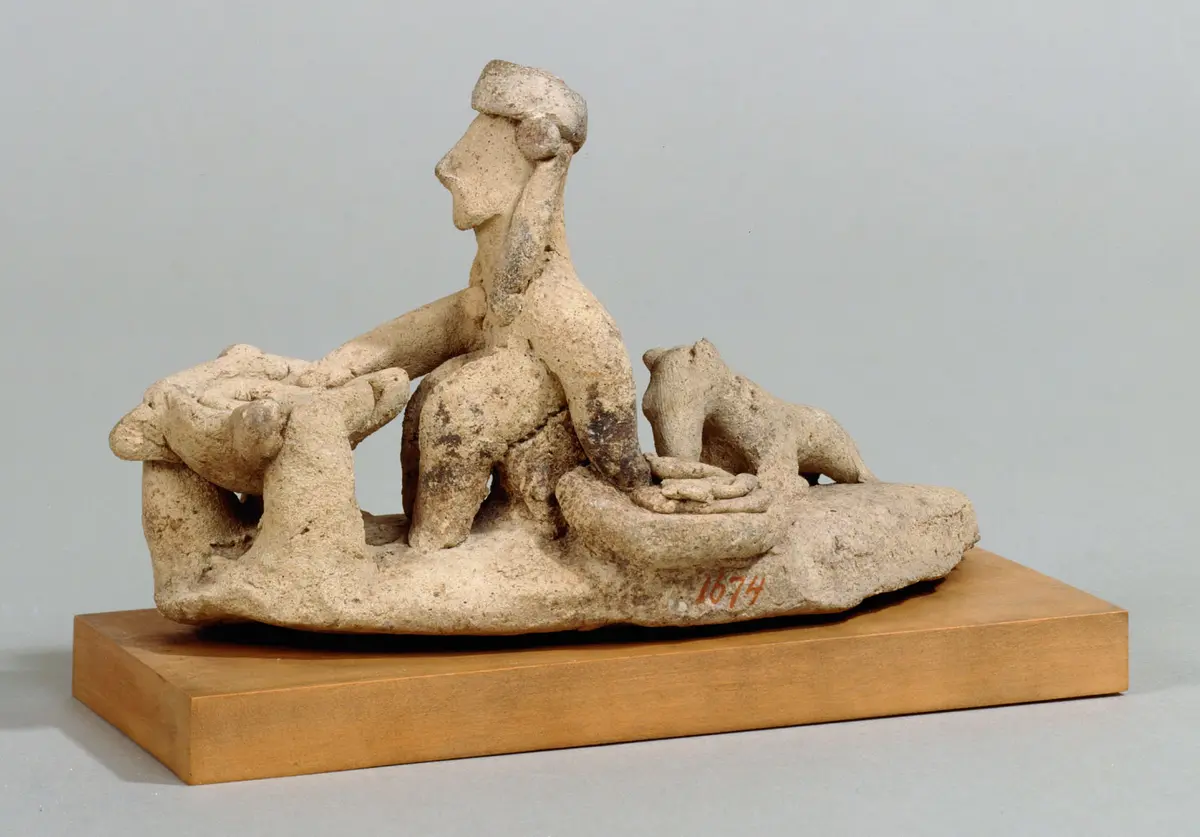
A group of a scene from everyday life involving a human figure and a quadruped. Handmade. They are both fixed on a crescent-shaped flat plaque. The human figure is female with two pellets for breasts. She is seated on a low stool. Long nose, pellets for ears, long locks of hair falling on either side of the neck on the shoulders. Thick turban around the head. In front of her, fixed at the end of the plaque, is a frying pan resting on a three-legged support. The pan is rounded, shallow and has four small vertical handles at the rim. Inside it there is a round cake (koullouri) in separate clay. The right arm of the human figure is stretched forward, and with her right hand she touches the rim of the pan. The left arm is stretched down and slightly to the back, to reach a flat round basket resting on the “floor” and containing four other cakes ready to be fried. Behind the human figure a quadruped (a dog?) with short legs and a long tail. It approaches, with its head almost touching the cakes in the basket. Traces of black paint on the hair, arms and legs of the human figure. Traces of black on the dog.Terra-cotta representations of scenes from everyday life were common during the Early-Middle Cypriote periods. They were produced during the Cypro-Archaic period, but then are rarer. The Vienna example is unique in the spontaneity of its scene. It can be compared only to the “scenic compositions” of the Early to Middle Cypriote period mentioned above. It recalls scenes from everyday life in the countryside of Cyprus that can still be seen today, such as when women prepare cakes for festive occasions.
A. Bernhard-Walcher u.a., Die Sammlung zyprischer Antiken im KHM. Sammlungskataloge des KHM Bd. 2, Wien 1999 (V. Karageorghis)
Time:
6. Jh. v. Chr.
Object Name
Statuette
Culture
Zyprisch
Location of discovery:
Athiénou (Golgoi, Zypern)
Material/technology:
Ton hellgelblich; Reste von roter und schwarzer Bemalung. Handgeformt
Dimensions:
H. 8,5 cm, L. 14,2 cm
Copyright
Kunsthistorisches Museum, Antikensammlung
Invs.
Antikensammlung, V 1674
Provenance
Ohnefalsch-Richter, Max; 1895 Kauf