Johannes Kleberger
1526 | Albrecht Dürer
In around 1525/1526, the wealthy banker Johannes Kleberger (1486–1546) returned to Nuremberg, the city of his birth, where in 1528 he married Felizitas Imhoff, the widowed eldest daughter of Willibald Pirckheimer. The latter was a friend of Dürer and an important Humanist. To Pirckheimer’s dismay, Kleberger left his new wife the following year. At first glance the portrait against a smooth background seems to have been inspired by classical portrait medals, but upon closer examination it can be seen to be a three-dimensional bust, balanced in the circular opening of a wall.
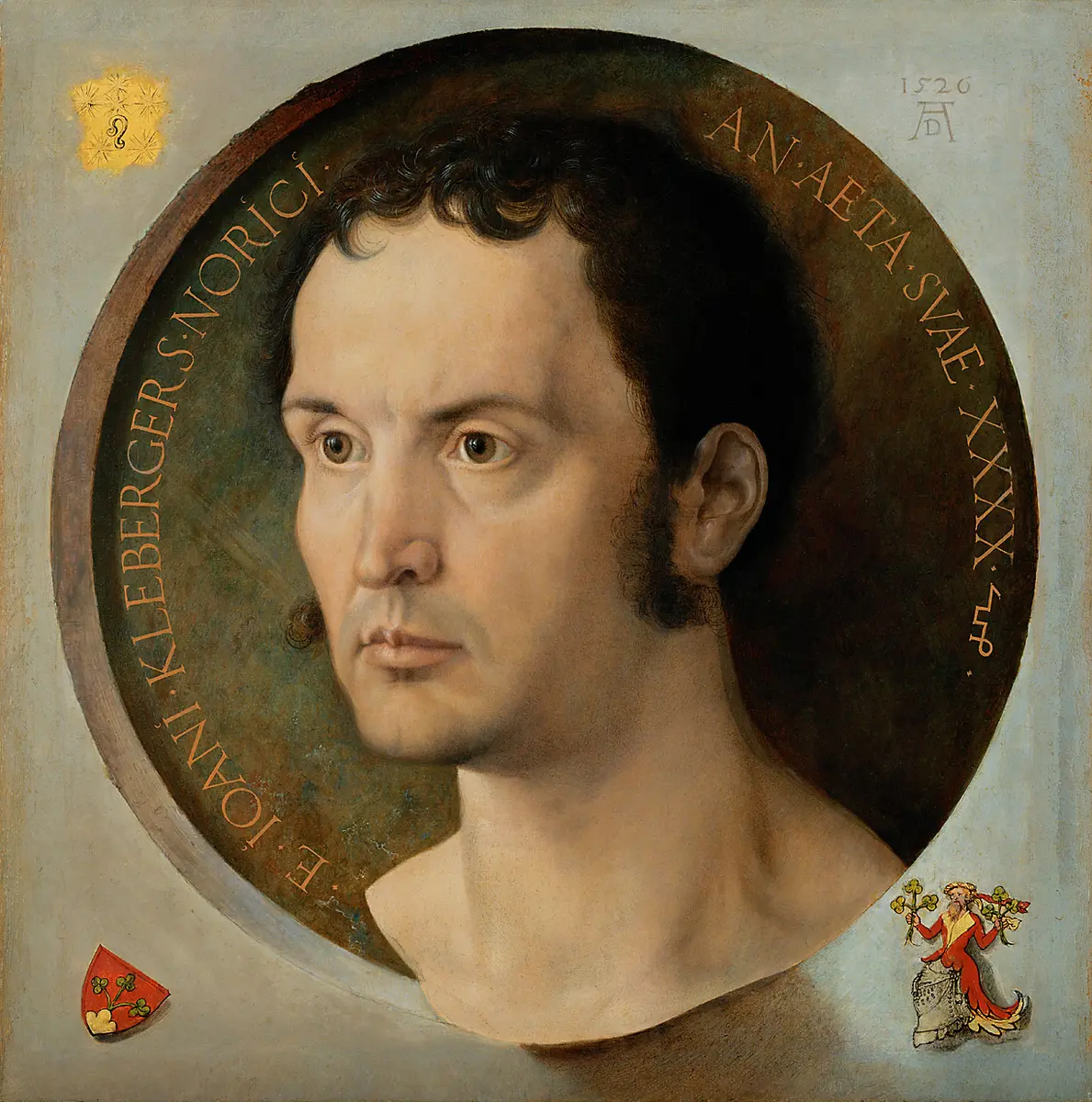
In around 1525/1526, the wealthy banker Johannes Kleberger (1486–1546) returned to Nuremberg, the city of his birth, where in 1528 he married Felizitas Imhoff, the widowed eldest daughter of Willibald Pirckheimer. The latter was a friend of Dürer and an important Humanist. To Pirckheimer’s dismay, Kleberger left his new wife the following year. At first glance the portrait against a smooth background seems to have been inspired by classical portrait medals, but upon closer examination it can be seen to be a three-dimensional bust, balanced in the circular opening of a wall.
Artist:
Albrecht Dürer (1471 Nürnberg - 1528 Nürnberg) DNB
Depiction/Person:
Johannes Sohn des Hans (?) Kleberger (1486 - 1546) DNB
Time:
1526
Object Name
Painting
Culture
German
Material/technology:
Limewood
Dimensions:
Overall: 36,5 cm × 36,5 cm
Framed: 49 cm × 48 cm × 4,5 cm
Signed
Inscribed with the monogram at upper right; dat. 1526
Inscribed
In den Ecken: links oben Tierkreiszeichen des Löwen in sechs Sternen, links unten Wappen; rechts unten Helm mit Wappenmännchen; Inschrift: E (FFIGIES). IOAN(N)I. KLEBERGERS. NORICI. AN(N)O. AETA(TIS). SVAE. XXXX.; sowie Zeichen des Regulus (im Sternbild des Löwen)
Copyright
Kunsthistorisches Museum, Gemäldegalerie
Invs.
Gemäldegalerie, 850
Provenance
Until 1564 David Kleberger, Lyon; until 1588 Coll. Willibald Imhoff, Nuremberg; acquired by Rudolf II in 1588