Judith and Holofernes
around 1530 | Lucas der Ältere Cranach
With cunning and courage, the Old Testament heroine succeeded in entering the camp of Holofernes outside the city of Bethulia. There she put an end to the threat his troops posed by decapitating the enemy general. Cranach’s large workshop created all of the known half-length versions of Judith around the year 1530. This striking concentration was apparently related to the founding of the Schmalkaldic League at that time: Judith became the symbolic figure of Protestant resistance to the armies of Charles V.
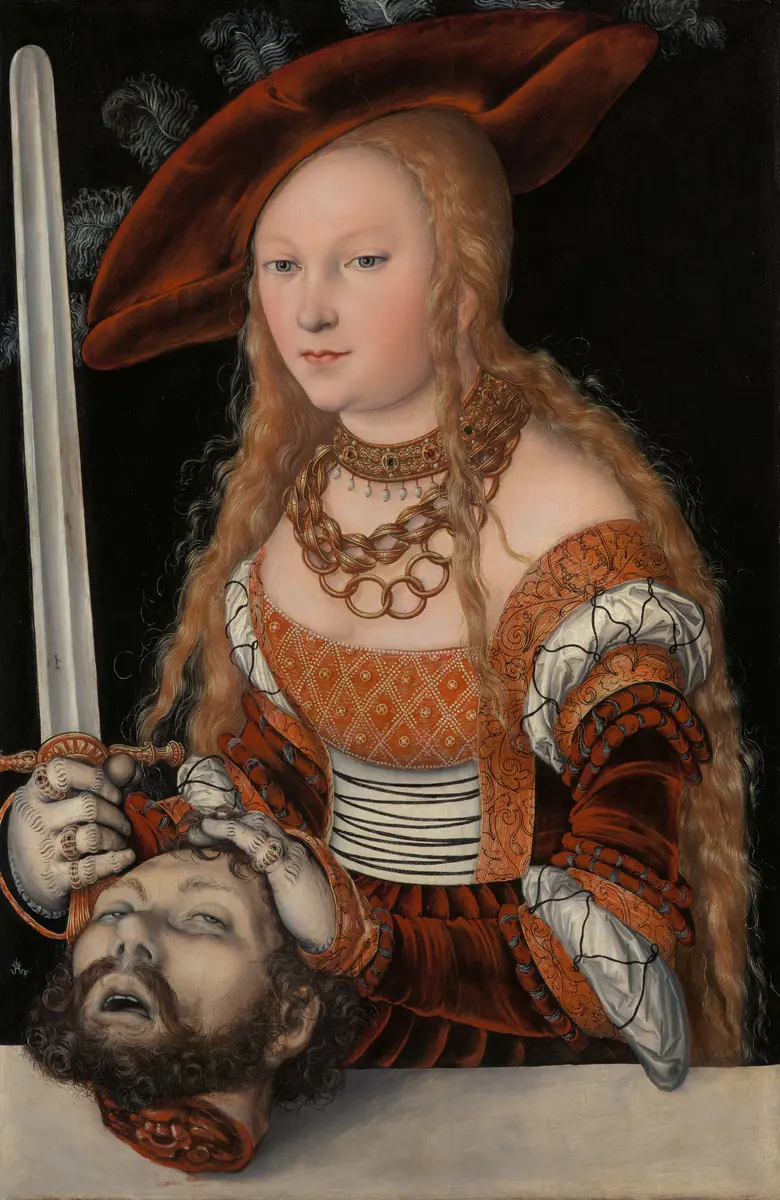
With cunning and courage, the Old Testament heroine succeeded in entering the camp of Holofernes outside the city of Bethulia. There she put an end to the threat his troops posed by decapitating the enemy general. Cranach’s large workshop created all of the known half-length versions of Judith around the year 1530. This striking concentration was apparently related to the founding of the Schmalkaldic League at that time: Judith became the symbolic figure of Protestant resistance to the armies of Charles V.
Artist:
Lucas der Ältere Cranach (1472 Kronach - 1553 Weimar) DNB
Time:
around 1530
Object Name
Painting
Culture
German
Material/technology:
Limewood
Dimensions:
Overall: 87,7 cm × 58,1 cm × 2,4 cm
Framed: 103 cm × 73 cm × 5,5 cm
Signed
Inscribed on the left side of the head of Holofernes with the snake with standing wings
Copyright
Kunsthistorisches Museum, Gemäldegalerie
Invs.
Gemäldegalerie, 858
Provenance
ca. 1610-1619 imperial collection Vienna;