Crowning of Thorns
around 1603 | Michelangelo Merisi, gen. Caravaggio
After interrogation by Pontius Pilate, Christ is made to wear a crown of thorns by the soldiers. He is thus mocked as King of the Jews. While previously regarded as a Roman or Neapolitan variation of a lost Caravaggio, this picture has now been confirmed as an original by the discovery of certain documents. Other arguments for its authenticity previously put forward included technical idiosyncrasies of the painter, such as the contour lines engraved with the stem of the brush to be found on Christ’s head, and on the shoulders, chest and hands of both henchmen.
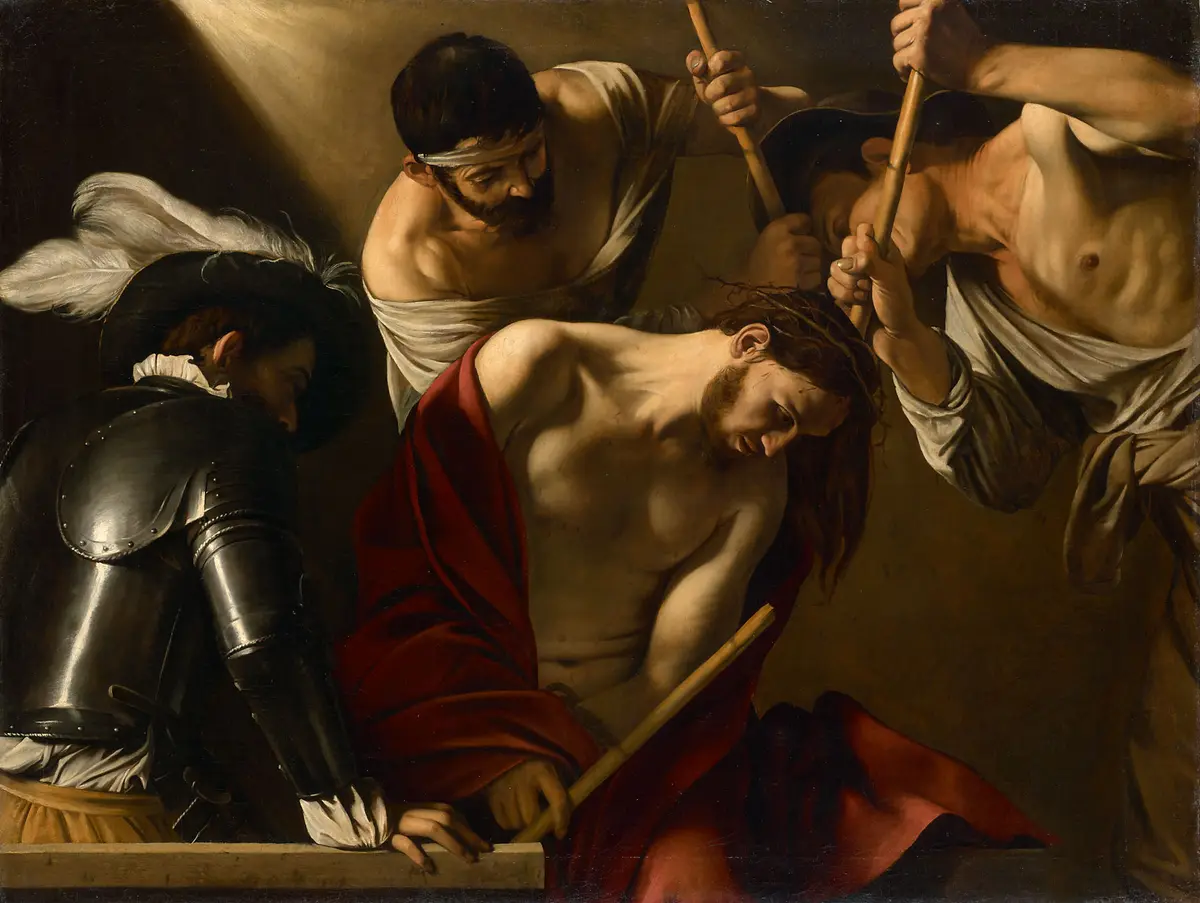
After interrogation by Pontius Pilate, Christ is made to wear a crown of thorns by the soldiers. He is thus mocked as King of the Jews. While previously regarded as a Roman or Neapolitan variation of a lost Caravaggio, this picture has now been confirmed as an original by the discovery of certain documents. Other arguments for its authenticity previously put forward included technical idiosyncrasies of the painter, such as the contour lines engraved with the stem of the brush to be found on Christ’s head, and on the shoulders, chest and hands of both henchmen.
Artist:
Michelangelo Merisi, gen. Caravaggio (1571 Mailand - 1610 Porto Ercole) DNB
Time:
around 1603
Object Name
Painting
Culture
Caravaggio and Caravaggesque painting
Material/technology:
Canvas
Dimensions:
Overall: 127 cm × 166,5 cm
Framed: 156 cm × 196 cm × 12 cm
Copyright
Kunsthistorisches Museum, Gemäldegalerie
Invs.
Gemäldegalerie, 307
Provenance
Rome, Coll. Marchese Vincenzo Giustiniani (inv. 1638, II, n.3); acquired around 1809 in Rome by Baron Ludwig von Lebzeltern for the Imperial Gallery; arrived in Vienna on 16 April 1816; 1816 in the Gallery