Vulcan and Maia
circa 1585 | Bartholomäus Spranger
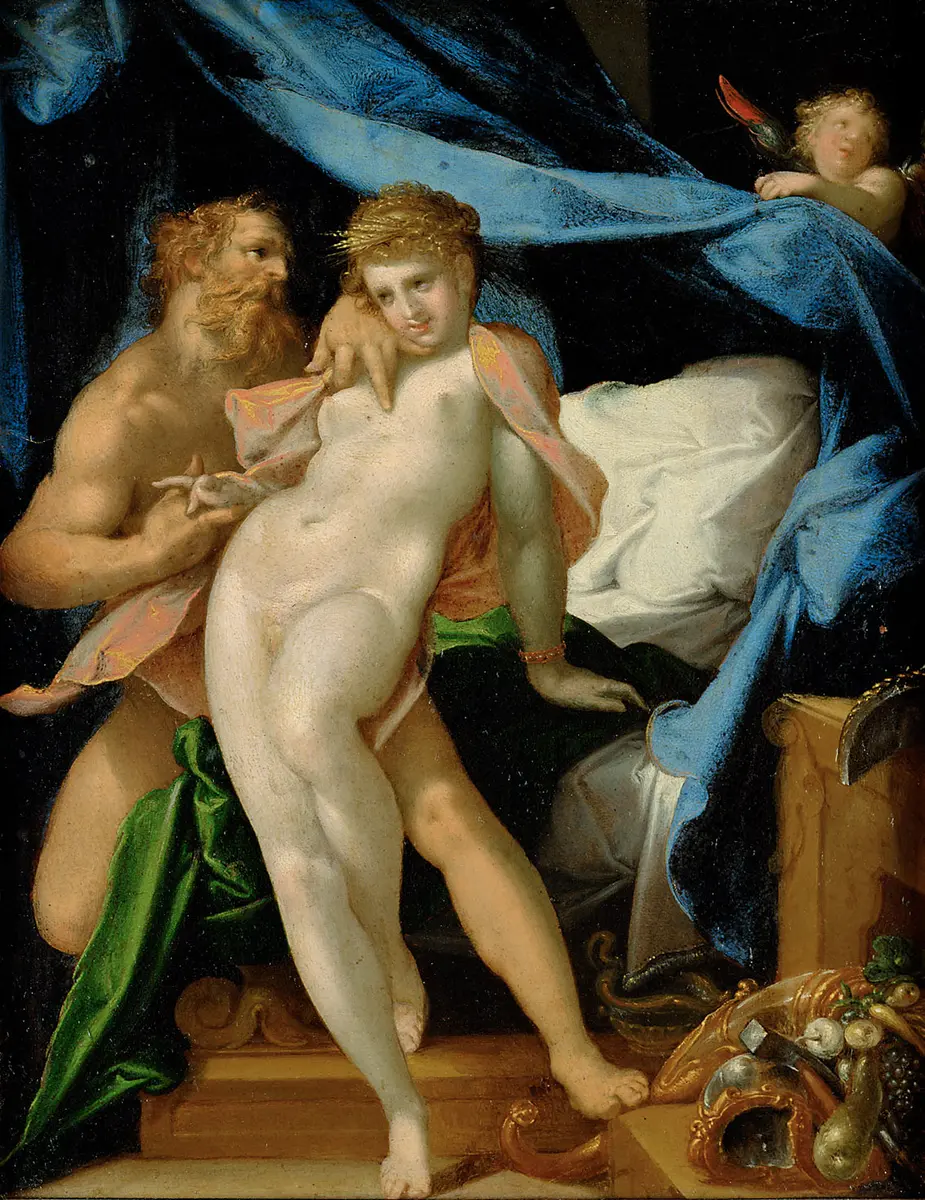
For this companion piece of Hercules and Omphale the artist chose the divine sphere as the setting for this erotically charged rendezvous. Repeatedly identified as Zeus, the bearded deity is, in fact, Vulcan, the god of fire and metalworking – this is clearly indicated by the pieces of armour and the sledgehammer. His female companion is generally identified as Maia, an ancient Italian goddess of spring, which would agree with her cornucopia and garland of corn. Spranger may have copied the lascivious pose of the goddess (who continues to live on in the name of the month of May) from an engraving by Agostino Veneziano depicting Cleopatra’s suicide. Inv.-Nr. GG 1128
For this companion piece of Hercules and Omphale the artist chose the divine sphere as the setting for this erotically charged rendezvous. Repeatedly identified as Zeus, the bearded deity is, in fact, Vulcan, the god of fire and metalworking – this is clearly indicated by the pieces of armour and the sledgehammer. His female companion is generally identified as Maia, an ancient Italian goddess of spring, which would agree with her cornucopia and garland of corn. Spranger may have copied the lascivious pose of the goddess (who continues to live on in the name of the month of May) from an engraving by Agostino Veneziano depicting Cleopatra’s suicide. Inv.-Nr. GG 1128
Artist:
Bartholomäus Spranger (1546 Antwerpen - 1611 Prag) DNB
Time:
circa 1585
Object Name
Painting
Culture
Netherlandish
Material/technology:
copper
Dimensions:
Overall: 22,2 cm × 17,5 cm × 0,1 cm
Framed: 34,5 cm × 29,5 cm × 3,2 cm
Copyright
Kunsthistorisches Museum, Gemäldegalerie
Invs.
Gemäldegalerie, 1128
Provenance
Treasury of Rudolf II.