Hercules and Omphale
around 1587 | Francesco da Ponte, gen. Francesco Bassano
Writers from antiquity tell that Hercules was sold as a slave for three years to Queen Omphale as a punishment for a violation of the holy site of Apollon. Hercules had to dress in Omphale‘s clothes and carry out “women’s work”. By contrast, Omphale seized the lion’s fur and club. The story served as a salutary warning for how quickly the strongest hero could be turned into a powerless slave by a woman. As usual Bassano embroidered the ancient story with numerous details from daily domestic life.
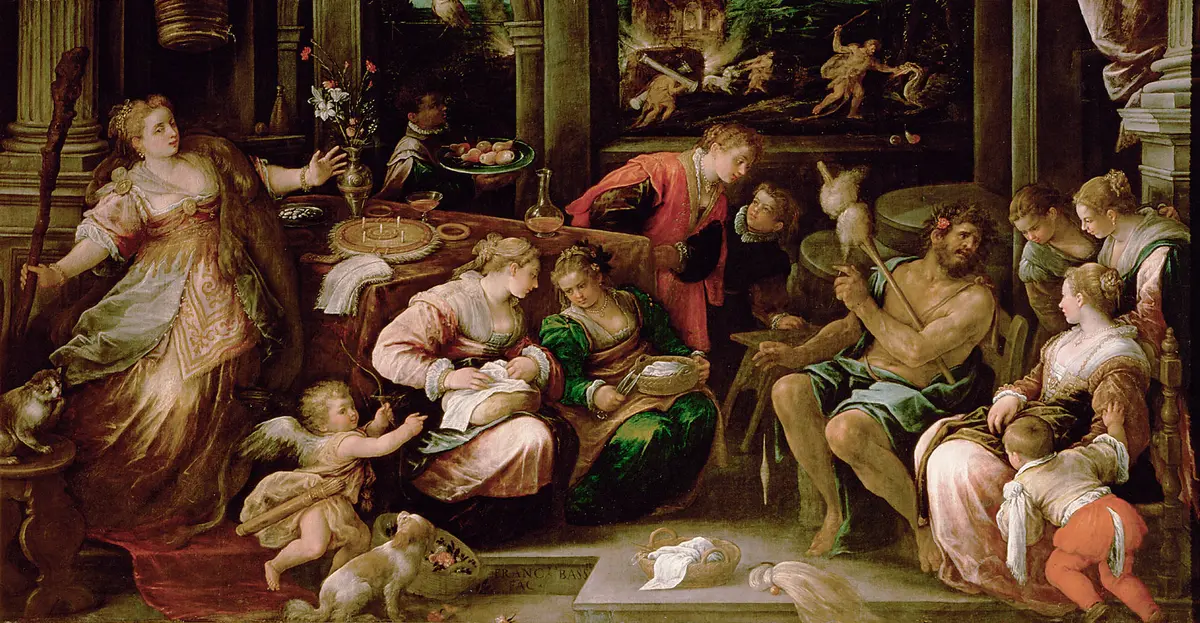
Writers from antiquity tell that Hercules was sold as a slave for three years to Queen Omphale as a punishment for a violation of the holy site of Apollon. Hercules had to dress in Omphale‘s clothes and carry out “women’s work”. By contrast, Omphale seized the lion’s fur and club. The story served as a salutary warning for how quickly the strongest hero could be turned into a powerless slave by a woman. As usual Bassano embroidered the ancient story with numerous details from daily domestic life.
Artist:
Francesco da Ponte, gen. Francesco Bassano (1549 - 1592 Bassano) DNB
Time:
around 1587
Object Name
Painting
Culture
Italian, Venetian
Material/technology:
Canvas
Dimensions:
178 x 374 cm
Signed
Marked in the middle at the bottom of the step: FRANCvs BASis FAC
Copyright
Kunsthistorisches Museum, Gemäldegalerie
Invs.
Gemäldegalerie, 3575
Provenance
Nicolas Chevalier, Castle la Chaussée; 1624-1648 Coll. Buckingham; 1685 Prague; 1876 to Vienna