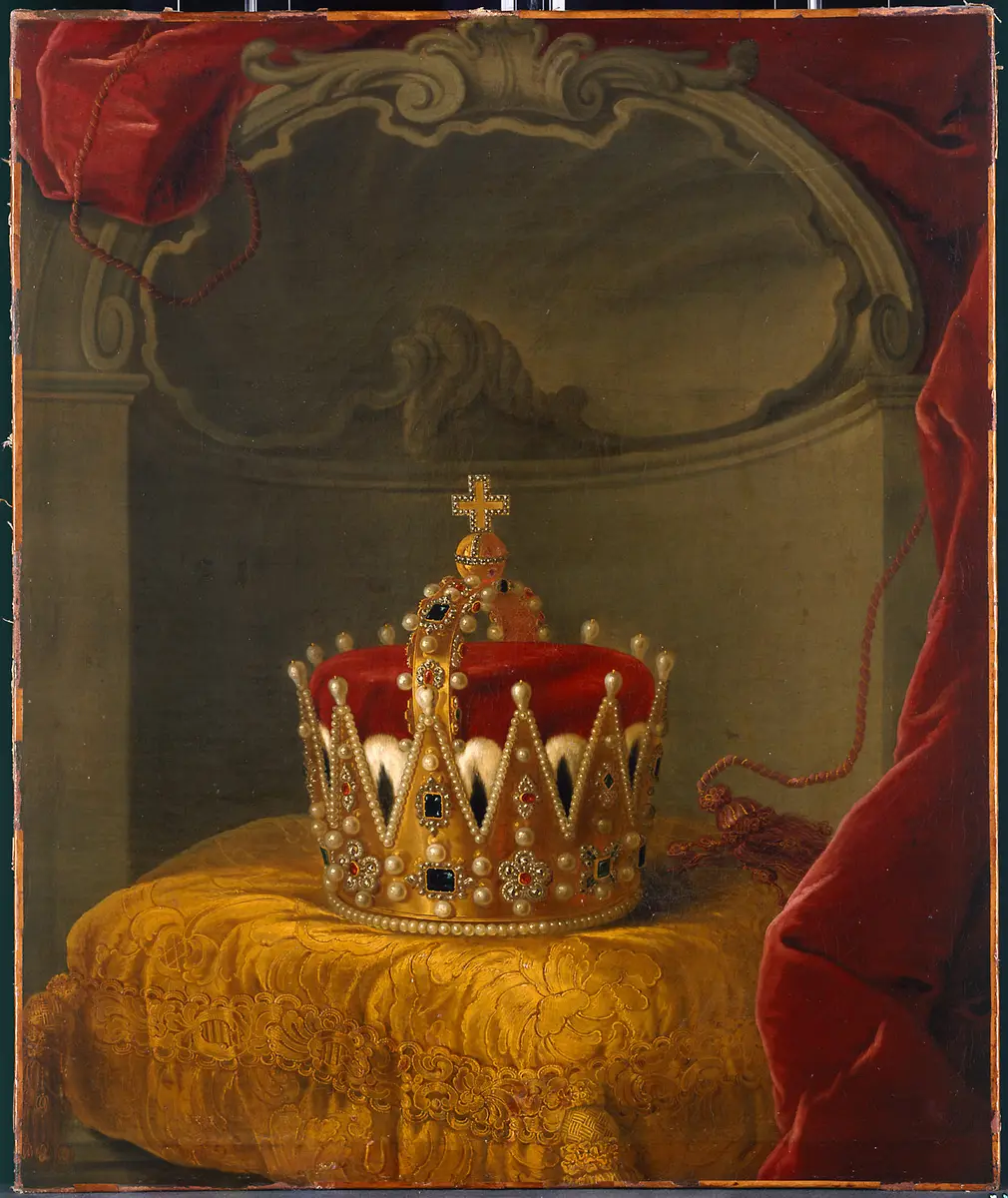
Darstellung der Barockkopie des österreichischen Erzherzoghutes
um 1765
The painting shows the Archducal Coronet made for the ceremonial entry into Frankfurt of Joseph II (1741-1790) on the occasion of his coronation as Roman-German king in 1764. From the time of Rudolf IV (1339-1365), the Habsburgs claimed the dignity of archdukes on their territory, and as an external sign they wore special insignia at certain ceremonies. These were necessary, in particular, for the hereditary homage, an enthronement ceremony in which the archduke confirmed the freedoms and privileges of the estates represented in assembly, whereupon the estates, as representatives of the land, swore an oath of allegiance to the Habsburg ruler. In 1616 Archduke Maximilian III donated a precious archducal coronet, which was kept with the relic of St. Leopold's skull at Klosterneuburg Abbey and was permitted to be taken from the abbey only for the hereditary homage and imperial enfeoffments. For this reason Joseph II needed a substitute, but it was not based on the archducal coronet with eight gables at Klosterneuburg but rather on the original 14th-century shape as found in a portrait of Rudolf IV. Thus the Archducal Coronet of 1764, consciously reaching back in history, has twelve high gables and a simple high arch with a globe topped by a cross in the middle. The underlying structure of this crown-like hat has been preserved in the Treasury (Inv. No. SK_WS_XIV_113), but without the decorations of precious stones, pearls and ermine found in the painting.
The painting shows the Archducal Coronet made for the ceremonial entry into Frankfurt of Joseph II (1741-1790) on the occasion of his coronation as Roman-German king in 1764. From the time of Rudolf IV (1339-1365), the Habsburgs claimed the dignity of archdukes on their territory, and as an external sign they wore special insignia at certain ceremonies. These were necessary, in particular, for the hereditary homage, an enthronement ceremony in which the archduke confirmed the freedoms and privileges of the estates represented in assembly, whereupon the estates, as representatives of the land, swore an oath of allegiance to the Habsburg ruler. In 1616 Archduke Maximilian III donated a precious archducal coronet, which was kept with the relic of St. Leopold's skull at Klosterneuburg Abbey and was permitted to be taken from the abbey only for the hereditary homage and imperial enfeoffments. For this reason Joseph II needed a substitute, but it was not based on the archducal coronet with eight gables at Klosterneuburg but rather on the original 14th-century shape as found in a portrait of Rudolf IV. Thus the Archducal Coronet of 1764, consciously reaching back in history, has twelve high gables and a simple high arch with a globe topped by a cross in the middle. The underlying structure of this crown-like hat has been preserved in the Treasury (Inv. No. SK_WS_XIV_113), but without the decorations of precious stones, pearls and ermine found in the painting.
Time:
um 1765
Object Name
Gemälde
Culture
Österreichisch, Wien (?)
Material/technology:
Öl auf Leinwand
Dimensions:
H. 78,5 cm, B. 65 cm
Copyright
Kunsthistorisches Museum, Weltliche Schatzkammer
Invs.
Schatzkammer, WS XIV 144