Der Mantel des österreichischen Kaisers
1830 | Philipp von Stubenrauch
The mantle with train is made of red velvet and studded with a pattern of gold-threaded embroidery. It consists of double eagles holding a sword and imperial orb in their talons and bearing the Crown of Rudolf II on their heads. The eagles' breasts are decorated with the Austrian red-white-red flag (Bindenschild). A wide border with sprays of oak-leaves, acorns and laurel leaves with fruit frames the mantle, which is hemmed with a yellowed band of white velvet embroidered with oak and laurel leaves. The mantle is fastened by means of twisted gold cords. The ermine lining of the hem has not been preserved. When Ferdinand I (1793-1875), the son of Francis I (1768-1835), was to be crowned as the "younger" king of Hungary in 1830, the Austrian emperor needed appropriate vestments. Given the fact that Austria did not have its first emperor until 1804, it was necessary to create such vestments from scratch. Significantly, the costume director of the Imperial and Royal Court Theatre, Philipp von Stubenrauch, was commissioned to design them, and three signed sheets of his sketches for the Austrian emperor's vestments have been preserved (Inv.Nos. SK_WS_XVI_B_40-42). The left of two adjacent designs on the second sheet is marked with a cross, suggesting that the emperor chose this design for the mantle that was later executed. In Friedrich von Amerling's famous portrait of Emperor Francis I (Inv.No. GG_8618) , he wears the mantle and the Crown of Rudolf II (Inv.No. SK_WS_XIa_1).
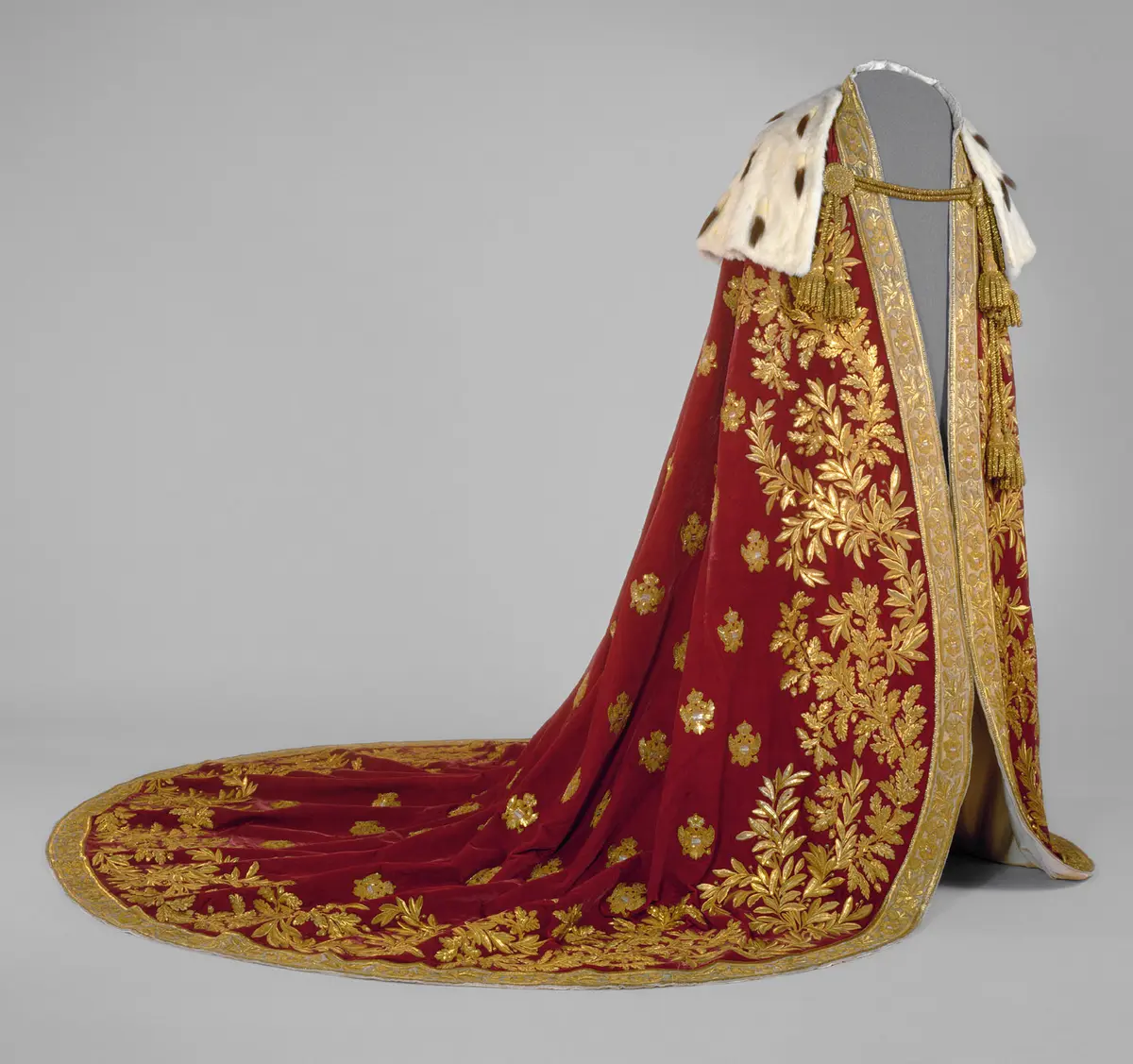
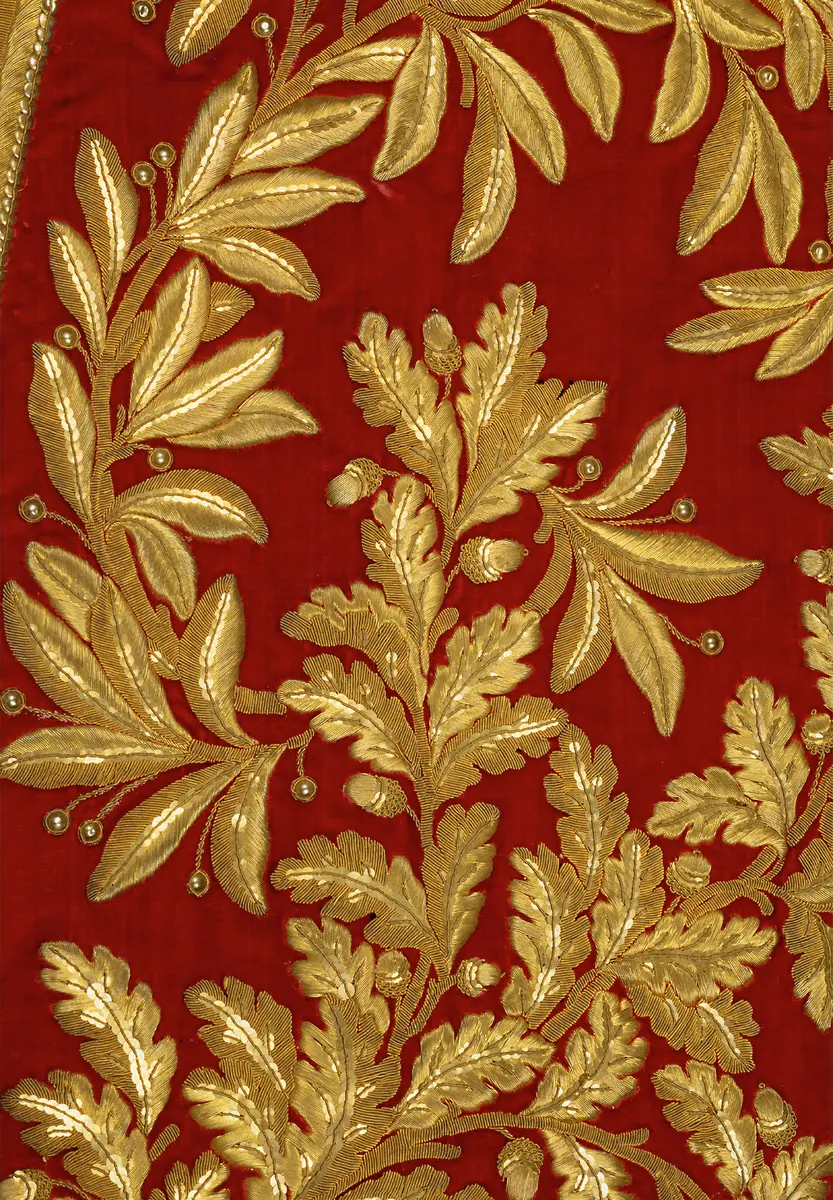
The mantle with train is made of red velvet and studded with a pattern of gold-threaded embroidery. It consists of double eagles holding a sword and imperial orb in their talons and bearing the Crown of Rudolf II on their heads. The eagles' breasts are decorated with the Austrian red-white-red flag (Bindenschild). A wide border with sprays of oak-leaves, acorns and laurel leaves with fruit frames the mantle, which is hemmed with a yellowed band of white velvet embroidered with oak and laurel leaves. The mantle is fastened by means of twisted gold cords. The ermine lining of the hem has not been preserved. When Ferdinand I (1793-1875), the son of Francis I (1768-1835), was to be crowned as the "younger" king of Hungary in 1830, the Austrian emperor needed appropriate vestments. Given the fact that Austria did not have its first emperor until 1804, it was necessary to create such vestments from scratch. Significantly, the costume director of the Imperial and Royal Court Theatre, Philipp von Stubenrauch, was commissioned to design them, and three signed sheets of his sketches for the Austrian emperor's vestments have been preserved (Inv.Nos. SK_WS_XVI_B_40-42). The left of two adjacent designs on the second sheet is marked with a cross, suggesting that the emperor chose this design for the mantle that was later executed. In Friedrich von Amerling's famous portrait of Emperor Francis I (Inv.No. GG_8618) , he wears the mantle and the Crown of Rudolf II (Inv.No. SK_WS_XIa_1).
Draft:
Philipp von Stubenrauch , (Hoftheaterkostümdirektor) (1784 - 1848) DNB
Artist:
Johann Fritz , (bürgerl. Goldstickereimeister, Ausführung) (19. Jh.) DNB
Time:
1830
Object Name
Textil
Culture
Wien
Material/technology:
Textil; Roter und weißer Samt, Goldstickerei in Sprengtechnik, Pailetten, Hermelin, weiße Seide
Dimensions:
L. 276 cm
Copyright
Kunsthistorisches Museum, Weltliche Schatzkammer
Invs.
Schatzkammer, WS XIV 117